The Block – Structure & Contents
Intent:
To explain what’s inside a blockchain block, how each component works, and why its structure guarantees data integrity and transparency.
Introduction – Inside the Heart of Blockchain
We often hear that blockchain is made up of “blocks,” but what exactly lives inside one of these blocks?
A block isn’t just a container – it’s a structured digital record designed to be traceable, secure, and immutable. Each block stores transaction data, metadata, and a unique cryptographic signature that links it to the block before it.
In this lesson, we’ll open up a block, piece by piece, to understand how its structure creates transparency and trust – without relying on any single authority.
What Is a Block Made Of?
Each block on the blockchain contains several key components that make it both functional and secure.
Let’s break them down:
1. Block Header – The DNA of the Block
The block header is like the block’s ID card. It holds essential information used to identify and verify the block’s authenticity.
Key elements include:
- Block Version: Defines which set of blockchain rules this block follows.
- Previous Block Hash: Links this block to the one before it, creating the chain.
- Merkle Root: A single hash representing all transactions in the block (we’ll explore this in a later lesson).
- Timestamp: When the block was created.
- Difficulty Target: The mining difficulty at the time.
- Nonce: A random number miners adjust to meet the difficulty target in Proof of Work systems.
Together, these elements ensure that each block is unique, traceable, and verifiable.
2. Block Body – The Data Itself
This is where the real action happens — the block body contains the transaction data.
Depending on the blockchain, this may include:
- Transaction Count: The number of transactions in the block.
- Transaction List: The actual transactions or operations (e.g., payments, smart contract executions).
For example, in Bitcoin:
- The body can store thousands of transactions, each detailing who sent what to whom, and when.
- Each transaction is hashed, and these hashes are combined into the Merkle Tree, with the final hash (Merkle Root) stored in the block header.
This allows nodes to verify transactions efficiently — without having to recheck the entire block history.
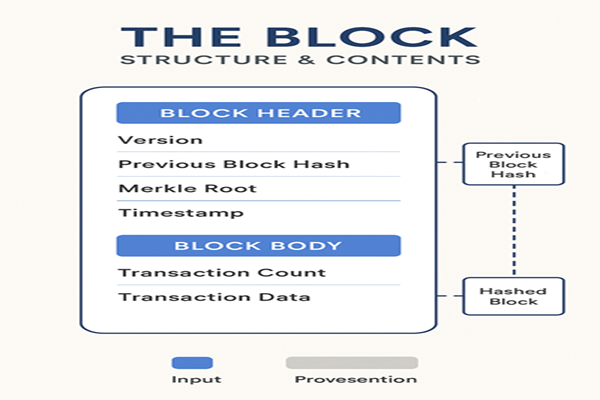
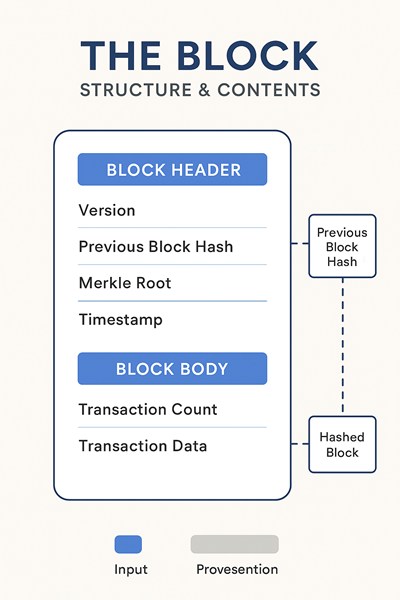
Visual Structure of a Block
Here’s how the parts fit together conceptually:
+————————————————–+
| Block Header |
|————————————————–|
| Version | Previous Hash | Merkle Root | Timestamp|
| Difficulty | Nonce |
+————————————————–+
| Block Body |
|————————————————–|
| Transaction Count: N |
| Transaction 1 → Hash |
| Transaction 2 → Hash |
| … |
+————————————————–+
Each block’s header secures its identity, and the body holds the transaction data that gives it purpose.
Why This Structure Matters
This organization isn’t arbitrary — it’s designed for security, efficiency, and scalability:
- The header ensures immutability (via hashes and links).
- The body allows efficient transaction verification.
- The Merkle Root enables simplified audits without downloading the full chain.
- The timestamp preserves chronological order across distributed nodes.
Each element supports blockchain’s three pillars – transparency, immutability, and decentralization.
How Blocks Are Added to the Chain
- Transaction Collection: Nodes collect valid transactions from the network.
- Block Formation: Miners bundle these into a block (header + body).
- Hashing: The block header is hashed to produce a unique fingerprint.
- Consensus Verification: Other nodes verify the block’s validity.
- Block Addition: Once validated, the block is linked to the chain permanently.
This process repeats continuously – creating an ever-growing, secure digital ledger.
Real-World Analogy – The Digital Ledger Page
Imagine each block as a page in a ledger.
- The header is like the page’s label: date, index number, and security seal.
- The body contains the list of all transactions written on that page.
- The hash of the previous page is stamped on the top – making it impossible to replace or reorder pages secretly.
That’s how blockchain preserves trust – by connecting every record to the one before it.
Example: Bitcoin Block Structure
Let’s look at a simplified real-world example:
{
“Block”: 820000,
“Hash”: “00000000000000000003b55a…”,
“Previous Hash”: “00000000000000000008d0ad…”,
“Merkle Root”: “aa3b9e4c2d9f…”,
“Timestamp”: “2025-10-19 14:35:42”,
“Transactions”: 1523
}
Every field plays a crucial role in verifying the block’s authenticity.
If someone changes even one transaction, the Merkle Root changes → the header hash changes → the network rejects it.
Key Takeaway
A blockchain block is a perfect balance of simplicity and sophistication.
It’s designed not only to store data — but to prove that the data hasn’t been altered.
Each element inside a block — from the header to the Merkle Root — works together to ensure that blockchain data remains transparent, permanent, and verifiable across the globe.
In the next lesson, we’ll dive deeper into Merkle Trees — How Blockchain Verifies Data Efficiently and see how cryptographic trees make verification lightning fast.