The Chain – Linking Blocks & Immutability

Lesson 7: The Chain – Linking Blocks & Immutability
Intent:
To explain how blockchain blocks are linked together, how hash references create immutability, and why this structure secures the entire transaction history.
Introduction – More Than Just Blocks
A single block can store data securely — but one block alone doesn’t make a blockchain.
The real power comes from how blocks are connected, forming an unbreakable sequence known as the chain.
Blockchain’s security doesn’t rely on hiding data. Instead, it relies on linking data so tightly together that changing history becomes practically impossible.
In this lesson, we’ll explore how blocks reference one another, how immutability emerges from this design, and why the blockchain’s past can be trusted — forever.
What Is “The Chain” in Blockchain?
The chain is the chronological connection of blocks, where each block contains a cryptographic reference (hash) to the previous block.
This creates a continuous sequence:
Block 1 → Block 2 → Block 3 → Block 4 → …
But it’s not just a simple pointer.
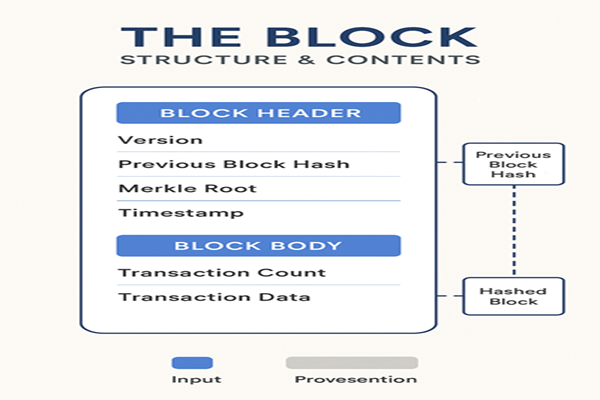
Each block stores the exact hash of the previous block’s header, meaning:
- If Block 2 changes, its hash changes
- That breaks the reference stored in Block 3
- Which invalidates every block after it
This dependency is the foundation of blockchain immutability.
How Blocks Reference Each Other
Each block contains a field called:
Previous Block Hash
This field does two critical things:
- It links the block to the one before it
- It locks in the previous block’s contents
Because the previous block’s hash is derived from its data, any alteration to that block changes its hash — and immediately exposes tampering.
In effect, each block vouches for the integrity of the block before it.
Immutability – Why History Can’t Be Changed
Blockchain immutability doesn’t mean data is magically unchangeable.
It means changing data is computationally and economically unrealistic.
To alter a transaction in an old block, an attacker would need to:
- Change the transaction data
- Recalculate that block’s hash
- Update the next block’s reference
- Recalculate every subsequent block
- Outpace the rest of the network’s consensus process
On large networks like Bitcoin or Ethereum, this would require enormous computing power and cost, making successful attacks extremely unlikely.
The Genesis Block – Where the Chain Begins
Every blockchain starts with a special first block called the Genesis Block.
- It has no previous block
- Its previous hash is often set to zero or a fixed value
- It establishes the initial state of the blockchain
From this single starting point, every other block inherits its security by referencing the one before it.
Why Linking Blocks Secures History
The chain structure provides several powerful guarantees:
- Tamper Evidence: Any modification breaks hash links
- Chronological Order: Transactions are permanently ordered
- Auditability: Anyone can verify the entire history
- Shared Truth: All nodes agree on one version of the past
Instead of trusting a central database, blockchain users trust the structure of the chain itself.
Real-World Analogy – Sealed Pages in a Ledger
Imagine a physical ledger where:
- Each page contains a summary of the previous page
- Pages are numbered and sealed together
- Removing or editing one page breaks all seals after it
That’s exactly how blockchain works – digitally and globally.
Once pages are added, history becomes visible, verifiable, and resistant to manipulation.
Immutability vs Finality
It’s important to understand that:
- Immutability means history is extremely hard to change
- Finality means the network agrees a block is permanent
Different blockchains reach finality at different speeds:
- Bitcoin: probabilistic finality (more confirmations = more security)
- Ethereum (PoS): faster economic finality
- Some newer chains: near-instant finality
But all rely on block linking to secure the past.
What Happens During a Fork?
Sometimes, two blocks are created at the same height, temporarily forming two chains.
The network resolves this by:
- Following the longest or most-work chain
- Discarding the shorter one
This process preserves immutability by ensuring one agreed-upon history survives.
Key Takeaway
The blockchain isn’t secure because it hides information —
it’s secure because it exposes structure.
By linking blocks through cryptographic hashes, blockchain creates a history that is:
- Transparent
- Verifiable
- Practically immutable
Each block strengthens the chain, and the longer the chain grows, the harder it becomes to rewrite the past.