
Validating Transactions – From Mempool to Block
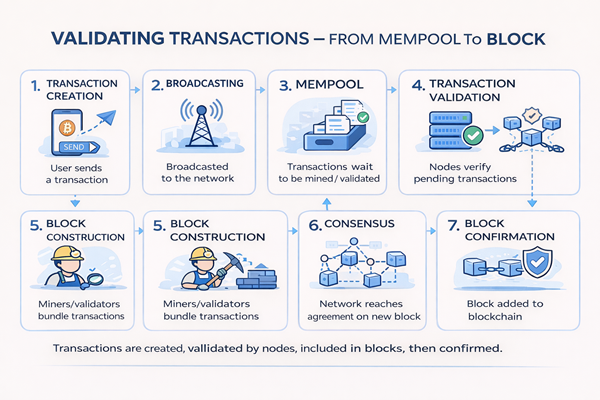
Lesson 10: Validating Transactions – From Mempool to Block
Intent:
“Validating Transactions – From Mempool to Block” To explain the full lifecycle of a blockchain transaction -how it is created, broadcast, stored in the mempool, validated by nodes, and finally included in a block.
Introduction – What Happens After You Click “Send”?
When you send a blockchain transaction, it doesn’t go straight into a block.
Instead, it enters a waiting area, gets checked by multiple nodes, competes with other transactions, and only then becomes part of the blockchain’s permanent history.
This behind-the-scenes journey ensures that:
- Only valid transactions are recorded
- Double-spending is prevented
- The network remains trustless and decentralized
In this lesson, we’ll follow a transaction step-by-step – from creation to confirmation.
Step 1: Transaction Creation
A transaction begins when a user:
- Enters recipient address
- Specifies amount
- Sets transaction fee
- Signs the transaction with their private key
This digital signature proves:
- Ownership of funds
- Authorization to spend them
- Integrity of the transaction data
Once signed, the transaction becomes immutable.
Step 2: Broadcasting to the Network
The signed transaction is broadcast to:
- A wallet’s connected node
- Or directly to multiple peers
From there, it spreads across the network using peer-to-peer gossip propagation.
Every node that receives it performs initial checks.
Step 3: Basic Validation by Nodes
Before accepting a transaction, nodes verify:
- Correct digital signature
- Sufficient balance
- Proper formatting
- No double-spending
- Valid fee structure
Invalid transactions are immediately rejected and never forwarded.
Valid ones move into the mempool.
What Is the Mempool?
The mempool (memory pool) is a temporary storage area where valid but unconfirmed transactions wait to be included in a block.
Key points about the mempool:
- Each node maintains its own mempool
- Mempools are similar but not identical
- Transactions are prioritized by fee
- Transactions can expire or be dropped
Think of the mempool as a waiting room for transactions.
Step 4: Transaction Selection by Miners / Validators
Block producers:
- Miners (PoW) or
- Validators (PoS)
select transactions from their mempool based on:
- Highest fees
- Validity
- Block size limits
Higher fees usually mean faster inclusion.
Step 5: Block Construction
The selected transactions are:
- Bundled into a block
- Organized into a Merkle Tree
- Assigned a block header
- Prepared for consensus
At this stage, the block is only proposed, not final.
Step 6: Consensus & Block Proposal
Depending on the consensus mechanism:
- PoW: Miners compete to solve a cryptographic puzzle
- PoS: A validator is chosen to propose the block
Once a valid block is found:
- It is broadcast to the network
- Other nodes verify it independently
Step 7: Block Verification by the Network
Nodes check:
- Block structure
- All transaction validity
- Correct previous block hash
- Consensus rules compliance
If valid:
- The block is added to the chain
- Transactions are removed from the mempool
If invalid:
- The block is rejected
- The proposer is penalized (in PoS systems)
Confirmations – When Is a Transaction Final?
A transaction is considered more secure as more blocks are added after it.
- 1 confirmation: Included in a block
- 6 confirmations (Bitcoin): Highly secure
- Finality-based chains: Near-instant finality
More confirmations = higher confidence.
Mempool Dynamics – Why Fees Matter
Mempools are dynamic:
- They grow during high demand
- Shrink when blocks clear transactions
- Can become congested
This leads to:
- Fee markets
- Transaction prioritization
- Replace-by-fee (RBF) mechanisms
Users can often speed up stuck transactions by increasing fees.
Real-World Analogy – Postal System
- Creating transaction → Writing a letter
- Broadcasting → Dropping it at the post office
- Mempool → Sorting facility
- Miner/Validator → Mail truck
- Block → Delivery batch
- Confirmations → Delivery receipts
Each step adds trust and verification.
Why This Process Secures the Network
This multi-layer validation ensures:
- No single node can cheat
- Invalid transactions never enter the ledger
- Consensus protects shared history
It’s slow by design – because security beats speed.
Key Takeaway
A blockchain transaction is not a single action – it’s a journey.
From mempool to block, every transaction is:
- Verified
- Prioritized
- Agreed upon
- Permanently recorded
This lifecycle is what makes blockchain trustless, transparent, and secure.
Next Lesson Preview
👉 Lesson 11: Fees, Gas & Incentives – Why Transactions Cost Money
We’ll explore transaction fees, gas models, and how incentives keep the network running.