Can Grok AI & Other AIs Predict Crypto Prices?
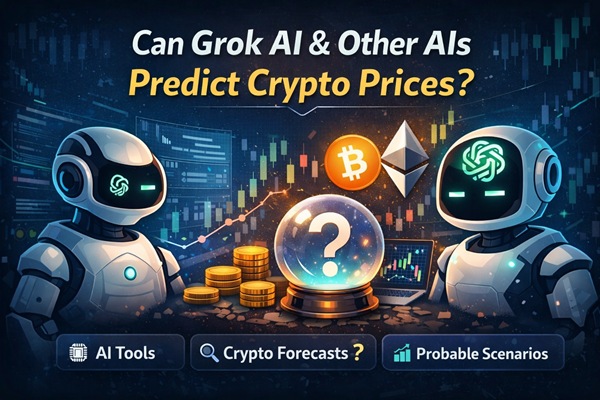
Can Grok AI & Other AIs Predict Crypto Prices?
(2026 Deep Dive – Trader’s Reality Check & Practical Insight)
Explore whether Grok AI, ChatGPT, and other AI tools can forecast Bitcoin, Ethereum, and altcoin movements; understand limits, real uses, and future potential.
Introduction – What Trading Taught Me About AI
We still remember the summer I got wiped out by a sudden altcoin dump. I had all the indicators lined up, a bullish thesis, and a gut feeling that the market was turning – until it didn’t. I barely noticed the tweet thread that flipped sentiment overnight.
A few months later, ChatGPT came out. Traders started asking: Can AI predict prices now? Then Grok AI showed up with even bigger claims.
I tried them all — not as blind believers, but as critical users.
Here’s what a seasoned trader has learned the hard way: AIs are not crystal balls. But they do change how we digest information, interpret trends, and make decisions.
In this 2000+ word guide, we’ll break down:
- What Grok AI and other AIs really are
- The real limits of price prediction
- Practical ways traders benefit from AI
- How AI fits into crypto workflows
- What the future might bring
No hype. No guaranteed price calls. Just grounded, real-market insight.
The Promise vs. The Reality of AI in Crypto
Artificial intelligence carries huge mystique in financial markets – especially crypto. People imagine:
“If AI just knew tomorrow’s price…”
Yet here’s the honest reality:
AI Isn’t Magic
AI systems like Grok, ChatGPT, Claude, or Bard are language models. They interpret patterns in language. They do not natively know everything about markets unless explicitly fed structured market data.
Markets Are Hard to Predict
Crypto markets are driven by:
- Macro news (Fed, interest rates)
- Regulation shifts
- Whale liquidity moves
- Social media sentiment
- Exchange events
- DeFi stress tests
- Narrative cycles
That’s more than just price history.
Prediction vs Probabilistic Outlooks
Any credible attempt to forecast price is probabilistic – pointing to ranges, not exact numbers. AIs can help discuss scenarios, not deliver guaranteed targets.
What Grok AI & Other AIs Are (Technically)
To judge prediction ability, we need to understand what these tools are:
Grok AI
- Developed by xAI / Elon Musk’s ecosystem
- Built for conversational intelligence
- Designed to be logical, grounded, up-to-date
- Can interpret text and summarize large datasets if provided
ChatGPT & Similar Models
- Trained on massive text + code corpuses
- Great at explaining concepts, summarizing data
- Not inherently connected to live market feeds
Other AI Tools in the Space
Some AI tools pair language models with:
- Real-time price APIs
- Technical indicator engines
- Sentiment feeds
- On-chain data
But that’s different from true price prediction.
Can AI Actually Predict Crypto Prices?
The Short, Honest Answer:
Not reliably, not consistently, and not alone.
Here’s why:
1. Most AIs Lack Real-Time Price Data
Unless built into a system with live market feeds, models like Grok or ChatGPT can’t see current price action.
They can only discuss price history up to their training cutoff or to data you input manually.
2. Price Prediction Requires Quantitative Modeling
Accurate forecasting needs:
- Time-series models
- Statistical learning
- Market microstructure analysis
- Live order book and volume flows
- Derivatives data (futures, funding rates, open interest)
Language models aren’t built for this — at least not by default.
3. Market Behavior Is Path Dependent
Price moves aren’t purely formulaic. They embed collective psychology:
- Fear
- Greed
- Liquidity traps
- Manipulation
- Narrative cycles
Language models can describe this behavior, but they don’t predict the next move autonomously.
But AI Can Still Add Real Value -Here’s How
Even if AIs can’t reliably spit out price targets, they help in ways most traders overlook.
1. Summarizing & Synthesizing Market Information
Crypto markets produce an avalanche of noise every day:
- Tweets
- News articles
- Forum threads
- Reddit AMAs
- YouTube clips
- Protocol upgrades
AIs can digest and summarize all that into something coherent.
Example use case:
“Grok, summarize sentiment around Bitcoin after ETF news.”
Instead of reading 20 articles, you get the gist — bullish, bearish, or mixed — in a few lines.
This is where serious traders save time.
2. Sentiment Interpretation
Sentiment is a key driver of short-term crypto moves. Retail flips from greed to fear fast.
AI can help you process:
- Social media sentiment
- News headlines
- Narrative shifts
This isn’t prediction — it’s context.
When sentiment flips, price often follows.
3. Explaining Technical Indicators
Most traders know the names: RSI, MACD, Fibonacci, VWAP, Bollinger Bands. Few understand how they interrelate with macro drivers.
AI can explain:
- What an indicator means
- What a divergence suggests
- Why volume spikes matter
- Bullish vs bearish setups
Still, this is interpretive, not predictive.
4. Constructing Scenarios, Not Numbers
Instead of saying:
“Bitcoin will hit $200k in 2026”
AI can help form structured scenarios:
- Bull Case: Strong ETF flows + halving + reduced selling
- Neutral Case: Range-bound price with mixed macro cues
- Bear Case: Regulatory clampdown + liquidity tightening
That’s useful — because real forecasting is about probability, not certainty.
5. Strategy Frameworks & Risk Management
A trader who knows risk is a trader who lives to trade another day.
AI can help structure:
- Position sizing guidelines
- Stop-loss reasoning
- Reward/risk frameworks
- Checklist workflows
These don’t predict price, but they help manage exposure.
6. Code Assistance & Backtesting
If you build bots or backtest strategies, AI can:
- Suggest code snippets
- Help debug scripts
- Explain backtesting outputs
- Translate ideas into structured logic
Important caveat: AI doesn’t validate performance. You must.
A Practical Comparison: AI vs Numeric Forecast Models
Here’s a simple table to clarify where AI stands relative to real forecasting systems:
| Feature | Language AI (Grok/ChatGPT) | Quantitative Models |
|---|---|---|
| Real-time price access | ❌ Unless integrated | ✔ |
| Live order book analysis | ❌ | ✔ |
| Statistical forecasting | ❌ | ✔ |
| Narrative summarization | ✔ | Limited |
| Sentiment analysis | ✔ | Limited |
| Scenario building | ✔ | ✔ |
| Direct price prediction | ❌ | Probabilistic only |
This highlights a key truth:
AI helps with context and reasoning; numeric models help with forecasting — and both together are stronger.
Where AI + Predictive Systems Shine
Some of the more useful systems emerging in 2026 combine:
- Live data feeds (price, order book, volume)
- Predictive models (ARIMA, LSTM, neural nets)
- On-chain metrics (active addresses, flows, staking rates)
- Sentiment indexes (Twitter/Reddit indicators)
- Language AI for interpretation
When you see bullish or bearish probability ranges from such systems, that’s not AI guessing – that’s the output of a layered analytical process.
Examples of platforms heading in this direction:
- Coin-Predictions.com (reliable crypto predictions + analysis)
- Dedicated quant dashboards with interpretive AI summaries
These aren’t “AI crystal balls.” They’re decision support systems.
Common Pitfalls Traders Fall Into With AI
Mistaking Explanation for Prediction
Just because an AI can explain what happened doesn’t mean it can forecast what will happen.
Believing AI Has Supernatural Insight
AI doesn’t see the future. It extrapolates from patterns and language.
Ignoring Model Limitations
AI trained on text doesn’t inherently know market microstructure unless engineered.
Blaming AI for Losses
AI tools improve thinking, not outcomes. You choose trades — you bear responsibility.
Looking for Certainty
Markets are uncertain by nature. Any tool offering certainty is lying.
The smartest traders use AI to reduce uncertainty, not eliminate it.
Putting All of This Into Practice – A Trader’s Workflow
Here’s a practical, repeatable process using AI responsibly:
Step 1: Data Ingestion
Pull live:
- Price
- Volume
- Funding rates
- Open interest
- Sentiment feeds
Step 2: Use Predictive Models
Run:
- Statistical forecasting
- Time series models
- Volatility scenarios
These produce probability bands — not fixed targets.
Step 3: Feed Results Into AI
Provide the model outputs to AI with your own questions:
- “Summarize this forecast”
- “What are unaccounted risks?”
- “How would sentiment affect this outlook?”
AI contextualizes, not predicts.
Step 4: Build Scenario Narratives
Use AI to structure:
- Bull case
- Base case
- Bear case
Include key assumptions and risks in each.
Step 5: Risk Manage
AI helps craft checklists, position sizing, and risk control processes.
Step 6: Decide – Then Execute
Your trading decisions shouldn’t come from AI alone. They should come from you informed by AI + models + experience.
Real World Example: Bitcoin Outlook with AI
This is an illustrative scenario based on real market logic — not a guaranteed prediction.
Bull Case Factors
- Strong institutional accumulation
- ETF inflows continue
- Halving cycle reduces miner selling
- On-chain demand rises
If these continue, a probabilistic model might show higher probability of bullish continuation.
Bear Case Factors
- Macro tightening continues
- Regulatory setbacks
- Derivatives deleveraging
- Network congestion issues
If sentiment flips, probability bands tighten or skew downward.
AI’s role:
Summarize these cases, identify risks, help interpret nuances.
The trade outcome still depends on what happens next, not what AI says.
The Future: Where AI & Markets Are Headed
AI in crypto will evolve toward:
- Better integration with live data
- Interpretive dashboards
- Hybrid forecasting + narrative systems
- Sentiment-driven probability analysis
- Trader-centric workflows
But one thing won’t change:
Prediction will remain probabilistic.
No AI will ever provide guaranteed outcomes.
That’s just market reality.
Frequently Asked Questions
1. Can Grok AI predict crypto prices?
No — Grok AI can help analyze information and build scenarios, but it doesn’t reliably forecast exact prices.
2. Are AI price predictions trustworthy?
They can offer probabilistic guidance when grounded in real data, but no model is foolproof.
3. How do AIs like ChatGPT and Grok assist traders?
By summarizing data, explaining context, and helping structure scenarios.
4. Do AI models use real-time data?
Only when integrated with APIs or external feeds.
5. Should traders rely on AI for entry/exit signals?
Not alone — AI should supplement human judgment and quantitative models.
6. Can AI forecast Bitcoin’s 2026 price?
AI can help frame potential scenarios, not guarantee specific price outcomes.
7. What’s better for forecasting — AI or quant models?
Neither alone — hybrid systems combining both are more powerful.
8. Do AI tools understand sentiment?
Yes, they can process sentiment if supplied with data.
9. Are there websites that combine AI with price prediction?
Yes — platforms like Coin-Predictions.com use structured forecasting with interpretive analysis.
10. Will AI replace traders?
No — it augments skill sets but doesn’t replace human decisions.
11. Can AIs generate buy/sell signals?
Not reliably on their own — use with risk management and models.
12. What’s the biggest limit of AI price prediction?
Lack of direct access to live market microstructure and numeric modeling.
13. Does AI help with risk management?
Yes — and that’s one of its most practical trader uses.
14. How should beginners use AI in crypto?
As educational tools and research assistants, not as trading robots.
15. Is AI good for long-term crypto analysis?
Yes — for narrative synthesis and fundamental interpretation.
Final Thoughts: A Trader’s Honest Take
AI like Grok, ChatGPT, and others are not price oracles. They are tools — powerful ones — that help us think better, research faster, and manage uncertainty more intelligently.
They don’t replace models, charts, or instincts. Instead, they augment them.
Crypto price prediction will always be about managing probabilities.
The smarter your tools, the better your framing of risk and reward.
Use AI to illuminate the fog — not declare a destination.