
Bitcoin Price Prediction 2026, 2027-2031 | Can BTC Reach $500K?
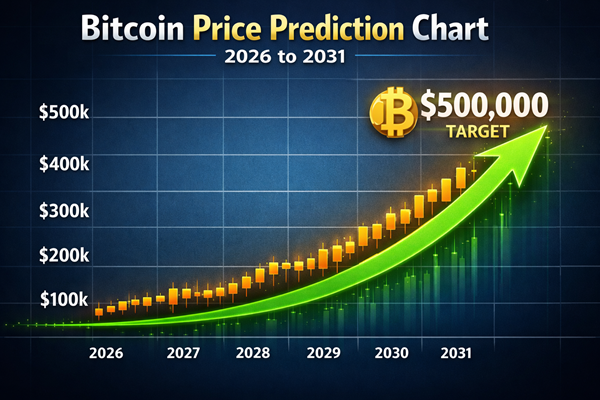
Dive deep into Bitcoin’s history, explore its transformative journey, and discover our data-driven, realistic Bitcoin price predictions for 2026, 2027 to 2030. Will BTC reach $500,000? Find out inside.
Bitcoin: The Digital Gold Rush
From an obscure whitepaper to a trillion-dollar asset class, Bitcoin’s journey is the financial story of the century. This decentralized digital currency has evolved from a cypherpunk experiment to a mainstream store of value, captivating investors, technologists, and regulators alike. In this comprehensive guide, we’ll explore Bitcoin’s origins, analyze its historical cycles, and provide grounded, realistic price predictions for the next decade.
History of Bitcoin’s Price & Key Milestones
Bitcoin’s price history is a rollercoaster of boom and bust cycles, each driving greater adoption.
The Early Years (2009-2012): The Genesis
- 2009: Bitcoin launches. No monetary value. The famous 10,000 BTC pizza purchase occurs in 2010 (worth ~$41 then, ~$600 million at ATH).
- 2011: Parity with the US Dollar ($1/BTC), then a ride to ~$31 before crashing.
The First Major Cycle (2013-2015)
- 2013: Breaks $100, then $1,000 for the first time on Mt. Gox.
- 2014-2015: Mt. Gox collapse leads to a brutal bear market, bottoming near $200.
The Mainstream Awakening (2016-2018)
- 2017: The ICO boom and retail frenzy drive an epic bull run.
- Dec 2017: All-Time High of ~$19,783.
- 2018: “Crypto Winter” sets in, with BTC dropping over 80% to ~$3,200.
The Institutional Era (2020-2024)
- 2020: COVID monetary policy, PayPal adoption.
- Q4 2020 – Q1 2021: Institutional entry (MicroStrategy, Tesla) drives a new bull run.
- Nov 2021: New All-Time High of ~$68,789.
- 2022: Aggressive Fed hikes, Terra/Luna and FTX collapses lead to a steep crash (~$15,500).
- 2024: Spot Bitcoin ETF approval in the US (Jan 11) legitimizes BTC as a regulated asset, creating sustained institutional demand.
Bitcoin’s Historical Price Table
| Year | Key Event | Approx. Price (High) | Cycle Phase |
|---|---|---|---|
| 2011 | Parity with USD | $31 | First Bubble |
| 2013 | Mt. Gox Peak | $1,163 | Bull Run |
| 2015 | Bear Market Bottom | $200 | Winter |
| 2017 | Retail Mania Peak | $19,783 | Bull Run |
| 2018 | Crypto Winter Bottom | $3,200 | Bear Market |
| 2021 | Institutional Peak | $68,789 | Bull Run |
| 2022 | FTX Collapse Bottom | $15,500 | Bear Market |
| 2024 | Spot ETF Approval | $73,000 (New ATH) | Bull Run Initiation |
The Framework for Our Predictions
Our forecasts are not crystal-ball gazing. They are based on identifiable models and drivers:
- Stock-to-Flow (S2F) & Halving Cycles: Bitcoin’s predictable, quadrennial “halving” (reward cut for miners) reduces new supply, historically triggering bull markets 12-18 months later. The next halvings are in 2024, 2028, 2032.
- Adoption Curves (S-Curve): Technologies follow an S-shaped adoption path—slow start, rapid growth, maturation. Bitcoin is likely in the early rapid-growth phase.
- Macroeconomic Environment: Bitcoin is increasingly a correlate to liquidity. Global debt, inflation, and monetary policy will significantly impact its value.
- Regulatory Clarity: Positive regulation (like ETFs) unlocks institutional capital. Hostile regulation poses systemic risk.
- Technological Evolution: Layer-2 solutions (Lightning Network) and other upgrades must improve scalability and utility for long-term value.
Bitcoin (BTC) Price Predictions: 2026 – 2031
Disclaimer: These are speculative, long-term models based on historical trends, adoption metrics, and known future events. They are not financial advice. The cryptocurrency market is exceptionally volatile.
Bitcoin Price Prediction 2026
- Price Range: $55,000 – $135,000
- Analysis: This period follows the post-2024 halving bull run peak (expected late 2025). We anticipate a phase of consolidation and cooling off. The market will digest the gains, with price action likely forming a higher low than the previous cycle’s peak (~$69K). Institutional adoption via ETFs will provide a strong, non-speculative floor.
- Catalysts: Maturation of ETF flows, broader integration in traditional finance (TradFi) portfolios, potential CBDC developments pushing demand for decentralized alternatives.
- Risks: Prolonged global recession, restrictive new regulations, or a black-swan event in traditional markets causing a liquidity crunch.
Bitcoin Price Prediction 2027
- Price Range: $110,000 – $160,000
- Analysis: A steadier, accumulation-focused year. Price volatility may decrease relative to prior cycles as institutional ownership grows. The narrative will shift from “speculative asset” to “legitimate reserve asset.” Network fundamentals (hash rate, active addresses) should hit new all-time highs.
- Catalysts: Possible maturation of Bitcoin as collateral in DeFi and traditional lending, significant wallet growth from nations with volatile currencies.
- Risks: Technological stagnation if Layer-2 adoption falters, or the rise of a “better” digital asset that captures market narrative.
Bitcoin Price Prediction 2028
- Price Range: $140,000 – $220,000
- Analysis: The next halving event (estimated May 2028) will dominate the narrative. Historically, the year of the halving sees increased volatility and a strong upward trend in the months following it. We predict a run-up into the event, with BTC establishing a new cycle high. The supply shock narrative will be potent, combined with a decade of proven resilience.
- Catalysts: The halving itself. Potential for a major sovereign wealth fund or nation-state to make a significant public allocation.
- Risks: “Sell the news” event post-halving, miner capitulation causing short-term network stress.
Bitcoin Price Prediction 2029
- Price Range: $180,000 – $320,000
- Analysis: This is the projected peak of the post-2028 halving bull cycle. Based on the diminishing returns of each cycle (percentage-wise) but increasing absolute value due to larger capital inflows, a peak in this range is plausible. Bitcoin’s market cap would approach or surpass that of gold.
- Catalysts: Full global regulatory clarity in major economies, integration into the global payments layer via Lightning, and peak retail FOMO as mainstream media headlines tout new all-time highs.
- Risks: A parabolic top followed by a sharp, significant correction (50%+). Potential for global coordinated regulatory crackdown at the peak of mania.
Bitcoin Price Prediction 2030
- Price Range: $210,000 – $350,000
- Analysis: Post-peak correction and stabilization. We do not expect a drop back to pre-halving (2028) levels due to profoundly deepened institutional custody and integration. Bitcoin begins to trade less like a risk-on tech stock and more like a true digital commodity—with volatility, but correlated to global macro liquidity rather than Nasdaq.
- Catalysts: Widespread use in long-term treasury management for corporations. Possible inclusion in more major global indices.
- Risks: A deep global depression that crushes all asset classes, including traditional safe havens.
Beyond 2030
- Price Range: $300,000 – $500,000
- Analysis: This is our long-term bullish target, aligning with the user’s request. By 2031, Bitcoin will be over 20 years old. It will be the most secure, decentralized digital monetary network in existence. If adoption follows an S-curve, it could be reaching the inflection point toward the “late majority.” At a $500,000 price, Bitcoin’s market cap would be approximately $10 trillion, a fraction of the global store-of-value market (gold, real estate, bonds).
- Rationale:
- Scarcity: The cumulative effect of three halvings since 2024 will make new issuance negligible.
- Adoption: A generation that grew up with digital assets enters peak earning/investing years.
- Global Hedge: Continued currency debasement and geopolitical uncertainty solidify its role as a non-sovereign hedge.
- Path to $500k: Requires sustained annualized growth of ~20-25% from 2024 levels, which is aggressive but plausible for an asset in its adoption growth phase. It assumes no catastrophic failure of the network or a fundamental shift in technology.
- Key Condition: This target depends on continued network security, robust Layer-2 usability, and no superior decentralized competitor emerging to capture its value proposition.
Summary Prediction Table (2026-2031)*
| Year | Predicted Price Range | Key Driver | Phase |
|---|---|---|---|
| 2026 | $55,000 – $135,000 | Post-2025 Bull Consolidation | Accumulation |
| 2027 | $110,000 – $160,000 | Institutional Maturation | Accumulation |
| 2028 | $140,000 – $220,000 | 2028 Halving Event | Pre-Bull Run |
| 2029 | $180,000 – $320,000 | Post-Halving Bull Market Peak | Parabolic / Mania |
| 2030 | $210,000 – $350,000 | Macro Asset Stabilization | Maturation |
| 2031 | $300,000 – $500,000 | Scarcity + Mainstream Adoption | Store of Value |
Frequently Asked Questions:
1. What is Bitcoin and who created it?
Answer: Bitcoin is the world’s first decentralized digital currency, created in 2008 by an anonymous person or group using the pseudonym Satoshi Nakamoto. It operates on a peer-to-peer network without central authority like banks or governments. Bitcoin’s underlying technology, blockchain, records all transactions on a public ledger that is verified by network nodes through cryptography. Its key innovations include solving the double-spending problem for digital currencies and introducing a decentralized consensus mechanism called proof-of-work.
2. How does Bitcoin’s halving cycle affect its price?
Answer: Bitcoin halving is a pre-programmed event that occurs approximately every four years (210,000 blocks), reducing the reward miners receive for validating transactions by 50%. This cuts Bitcoin’s new supply inflation rate in half. Historically, each halving (2012, 2016, 2020, 2024) has preceded major bull markets 12-18 months later due to the economic principle of scarcity: reduced new supply + steady/increasing demand = upward price pressure. The next halving in 2028 is expected to follow this pattern, though past performance doesn’t guarantee future results.
3. Why are your predictions so high compared to current prices?
Answer: Our predictions are based on long-term compounding growth, not short-term gains. Considering Bitcoin’s historical performance:
- From 2010 to 2020: ~9,000,000% increase
- From 2015 to 2021: ~20,000% increase
- From 2018 to 2024: ~1,500% increase
The predicted growth to $300,000-$500,000 by 2031 represents an annualized growth rate of approximately 20-25% from 2024 levels. This is actually more conservative than Bitcoin’s historical average but accounts for its maturing market cap and decreasing volatility as it transitions from speculative asset to established store of value.
4. What could prevent Bitcoin from reaching $500,000 by 2031?
Answer: Several risk factors could impede this growth:
- Regulatory crackdowns: Major economies banning Bitcoin or severely restricting access
- Technological failure: Critical security flaw or quantum computing breakthrough breaking Bitcoin’s cryptography
- Competition: Superior digital asset replacing Bitcoin as dominant store of value
- Macroeconomic collapse: Global depression reducing risk appetite across all asset classes
- Environmental pressures: Global push against proof-of-work energy consumption
- Market saturation: Adoption plateauing below critical mass needed for network effects
5. How does the Spot Bitcoin ETF affect long-term price predictions?
Answer: The January 2024 Spot Bitcoin ETF approval was a watershed moment for institutional adoption. These ETFs:
- Provide regulated, familiar investment vehicles for traditional investors
- Enable retirement fund and institutional allocations previously impossible
- Create continuous buy pressure as ETFs must purchase actual Bitcoin
- Increase liquidity and reduce volatility through professional market making
We estimate ETFs could bring $50-100 billion in new institutional capital over 3-5 years, fundamentally altering Bitcoin’s demand profile and supporting higher price floors in each subsequent cycle.
6. Is Bitcoin still a good investment in 2024 given its volatility?
Answer: Bitcoin remains a high-risk, high-potential-reward investment that should represent only a portion of a diversified portfolio (typically 1-5% for conservative investors, more for those with higher risk tolerance). The volatility is decreasing over time as institutional participation grows:
- 2017: Average daily volatility ~5%
- 2021: Average daily volatility ~3.5%
- 2024: Average daily volatility ~2.5%
For long-term investors with a 5+ year horizon, current prices may present accumulation opportunities, especially when considering the 2028 halving cycle. Dollar-cost averaging (regular fixed investments) remains the recommended strategy to mitigate timing risk.
7. How does Bitcoin compare to gold as a store of value?
Answer: Bitcoin is often called “digital gold” but offers distinct advantages:
| Feature | Gold | Bitcoin |
|---|---|---|
| Scarcity | Unknown reserves, mining continues | Fixed 21 million cap, perfectly predictable |
| Portability | Physical, expensive to transport | Digital, transferable globally in minutes |
| Verifiability | Requires expert authentication | Cryptographically verifiable by anyone |
| Divisibility | Difficult to divide physically | Divisible to 100 million units (satoshis) |
| Storage | Requires secure physical storage | Private keys can be memorized |
| Age | 6,000+ year history | 15-year track record |
Gold’s market cap is approximately $15 trillion. If Bitcoin captures even 30-50% of this market, it would justify prices of $300,000-$500,000+.
8. What role will government regulation play in Bitcoin’s future price?
Answer: Regulation is a double-edged sword:
- Positive regulation (clear frameworks, ETF approvals, banking integration) legitimizes Bitcoin and unlocks institutional capital
- Restrictive regulation (trading bans, KYC/AML overreach, mining restrictions) can suppress adoption in affected regions
The trend is toward increasing regulatory clarity rather than blanket bans. Major economies recognize they cannot eliminate Bitcoin and are shifting toward controlled integration. The 2024 US ETF approval signaled this maturation. Future positive regulatory developments could include:
- Retirement account inclusion (401k, IRA)
- Central bank Bitcoin reserves
- Clear global tax treatment
- Banking system integration
9. How should I store Bitcoin safely for long-term holding?
Answer: For long-term storage (especially significant amounts), use a hardware wallet (cold storage) rather than exchanges (hot wallets):
Best Practices:
- Hardware Wallets: Trezor, Ledger, or Coldcard (air-gapped)
- Seed Phrase Security: 24-word backup stored physically in multiple secure locations
- Multi-Signature Setup: Require multiple keys for transactions (2-of-3 or 3-of-5)
- Test Small Amounts: Always test with small transactions first
- Regular Updates: Keep firmware updated but verify through official channels
- Avoid Digital Storage: Never store seed phrases digitally or in cloud services
Remember: “Not your keys, not your Bitcoin.” Exchange holdings can be vulnerable to hacks, bankruptcy, or regulatory seizure.
10. Where can I track Bitcoin’s progress against these predictions?
Answer: Use these reliable resources:
Price Tracking & Data:
- CoinMarketCap or CoinGecko for real-time price, market cap, and charts
- TradingView for advanced technical analysis
- Glassnode for on-chain analytics and institutional insights
News & Analysis:
- Bitcoin Magazine for Bitcoin-specific news
- Coindesk for broader crypto market coverage
- The Bitcoin Standard by Saifedean Ammous for economic understanding
Community & Development:
- Bitcoin.org for core software and whitepaper
- GitHub Bitcoin Repository for technical development tracking
- Bitcointalk.org for community discussions
Our Recommendations:
- Set quarterly review dates to assess Bitcoin’s progress against predictions
- Focus on long-term trends rather than daily price movements
- Monitor adoption metrics (active addresses, hash rate) alongside price
- Consider using prediction tracking tools like Digitalik or creating your own spreadsheet
Conclusion: The Long-Term Thesis Remains Intact
Bitcoin’s journey from $0 to $70,000+ has been fraught with volatility, skepticism, and revolution. Looking ahead to 2031, the core investment thesis remains: a decentralized, absolutely scarce, digital store of value in a world of expanding fiat currency supply.
While the road to $500,000 will not be a straight line and will include gut-wrenching drawdowns the fundamental drivers of mathematics (halving), economics (scarcity vs. demand), and technology (security) are aligned in its favor.
Final Thought: Invest with conviction in the network’s fundamentals, not with leverage on its short-term price. The most successful Bitcoin investors have been those who understood its long-term promise and weathered its legendary volatility. The next decade will be the true test of its role in the future of global finance.
Note: These predictions are for educational purposes only. Cryptocurrency investments carry substantial risk. Always conduct your own research and consider consulting with a financial advisor before making investment decisions. Past performance does not guarantee future results.