Coins vs Tokens – What’s the Difference?
Coins vs Tokens – What’s the Difference?
Intent: Explain the difference between native blockchain currencies (coins) and tokens built using token standards.
The Confusion Everyone Has
Bitcoin, Ether, USDT, NFTs, governance tokens—
they’re all called “crypto,” but they’re not all the same thing.
One of the most common beginner questions is:
If everything lives on a blockchain, why do we call some assets coins and others tokens?
The difference matters-not just technically, but economically and structurally.
Let’s clear it up.
The Simple Rule to Remember
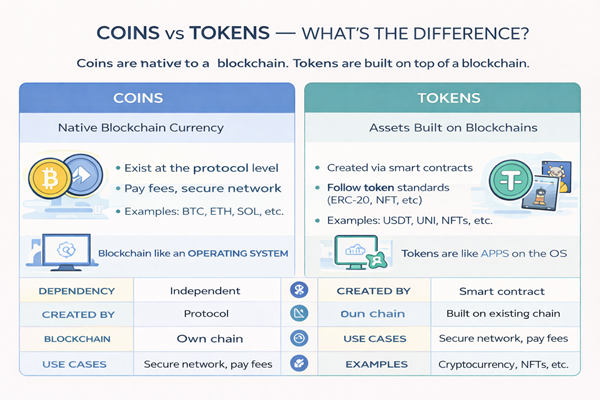
Coins are native to a blockchain.
Tokens are built on top of a blockchain.
Everything else flows from this idea.
What Is a Coin?
A coin is the native currency of a blockchain.
It exists at the protocol level and is essential to how the chain operates.
Examples of Coins
- Bitcoin → BTC (Bitcoin blockchain)
- Ethereum → ETH (Ethereum blockchain)
- Solana → SOL (Solana blockchain)
- Litecoin → LTC (Litecoin blockchain)
What Coins Are Used For
Coins typically serve these roles:
- Paying transaction fees (gas)
- Incentivizing miners or validators
- Securing the network (staking or mining)
- Acting as the base unit of value
Without its coin, a blockchain cannot function.
Technical Insight (High-Level)
Coins:
- Are defined directly in the blockchain protocol
- Exist without smart contracts
- Are tracked by the core ledger rules
You can’t “deploy” a coin—you launch a new blockchain.
What Is a Token?
A token is a digital asset created using smart contracts on an existing blockchain.
Tokens:
- Do not have their own blockchain
- Depend entirely on the host chain
- Follow standardized rules (token standards)
Common Token Examples
- USDT (ERC-20) on Ethereum
- USDC on multiple chains
- UNI (Uniswap governance token)
- LINK (Chainlink token)
- NFTs (ERC-721, ERC-1155)
They all live on top of a blockchain-not inside its core protocol.
Token Standards – The Rules Tokens Follow
Token standards define:
- How tokens are created
- How they’re transferred
- How wallets and apps interact with them
Popular Token Standards
| Standard | Chain | Purpose |
|---|---|---|
| ERC-20 | Ethereum | Fungible tokens |
| ERC-721 | Ethereum | NFTs |
| ERC-1155 | Ethereum | Multi-token standard |
| SPL | Solana | Fungible & NFT tokens |
| BEP-20 | BNB Chain | Ethereum-compatible tokens |
Standards ensure interoperability across wallets, apps, and exchanges.
Coins vs Tokens – Side-by-Side Comparison
| Feature | Coins | Tokens |
|---|---|---|
| Blockchain | Own blockchain | Built on existing chain |
| Created by | Protocol | Smart contract |
| Fees paid in | Native coin | Native coin |
| Dependency | Independent | Dependent |
| Examples | BTC, ETH, SOL | USDT, UNI, NFTs |
Why Tokens Exist at All
If tokens need a blockchain anyway-why not just create new coins?
Because tokens are:
- Faster to launch
- Cheaper to deploy
- More flexible
- Easier to integrate
Tokens enable innovation without building a whole blockchain.
Real-World Analogy
Think of a blockchain like an operating system.
- The coin is the system’s native currency
- Tokens are apps running on the OS
- Smart contracts are the app logic
You don’t build a new OS to make an app—you deploy it on an existing one.
Multi-Chain Tokens
Some tokens exist on multiple blockchains.
Example:
- USDT on Ethereum, Tron, Solana
Important detail:
These are separate tokens, not the same asset magically moving between chains.
Bridges and wrapped tokens handle cross-chain movement.
Fees: Why You Still Need Coins
Even if you only use tokens:
- Gas fees are always paid in the native coin
- Tokens cannot pay for execution themselves
Example:
- Sending USDT on Ethereum → requires ETH
- Minting an NFT → requires ETH or SOL
Coins power the machine.
Security & Risk Differences
Coins:
- Secured by the full consensus mechanism
- Generally more robust
Tokens:
- Security depends on smart contract quality
- Vulnerable to bugs, exploits, and admin risk
Not all tokens are equally safe.
Why This Distinction Matters
Understanding coins vs tokens helps you:
- Evaluate crypto projects properly
- Understand fee structures
- Assess risk
- Design dApps and token models
Many “crypto projects” are actually tokens, not blockchains.
Key Takeaway
- Coins are the foundation
- Tokens are the innovation layer
- One secures the network
- The other unlocks functionality
Blockchain without coins can’t run.
Blockchain without tokens can’t evolve.
Next Lesson Preview
👉 Token Economics (Tokenomics) – Supply, Utility & Incentives
We’ll explore how tokens gain value, how supply is controlled, and why design choices matter.