Bitcoin Price Prediction 2026: Bull, Bear & Sideways Scenarios
Bitcoin Price Prediction 2026 – 3 Scenarios & What They Mean
I still remember watching Bitcoin jump $5,000 in a single day while my coffee went cold. No breaking news. No fireworks. Just pure, chaotic price action. That’s Bitcoin for you. And heading into 2026, that same chaos is back — only now the stakes are bigger, the players are richer, and the opinions are louder.
Bitcoin isn’t a niche internet experiment anymore. It’s a trillion-dollar asset that Wall Street tracks, governments debate, and everyday investors argue about in group chats.
So the question isn’t just “Will Bitcoin go up?”
The real question is: What kind of year will 2026 actually be for Bitcoin?
Let’s break it down into three clear, realistic scenarios: bullish, neutral, and bearish — without the hype, without the fluff, and with real-world logic.
Where Bitcoin Stands in Early 2026
Before guessing the future, you need to look at the present.
Right now, Bitcoin is hovering around $90,000. That’s a strong number by any historical standard. But it’s also noticeably below the all-time high of $126,000, reached in October 2025.
Here’s the mood of the market in simple terms:
- Price: Around $90K, moving sideways
- Volatility: Still wild, but not as explosive as peak bull runs
- ETF Flows: Some inflows, some outflows — not the nonstop buying many expected
- Sentiment: Half bullish, half nervous
It feels like the market is… waiting. Not crashing. Not mooning. Just pausing. That’s usually when the most interesting moves begin.
Bitcoin already had its euphoric phase in 2025. 2026 feels more like a crossroads year. A digestion year. A “decide what comes next” year.
Scenario 1: Bullish — Bitcoin Runs Again
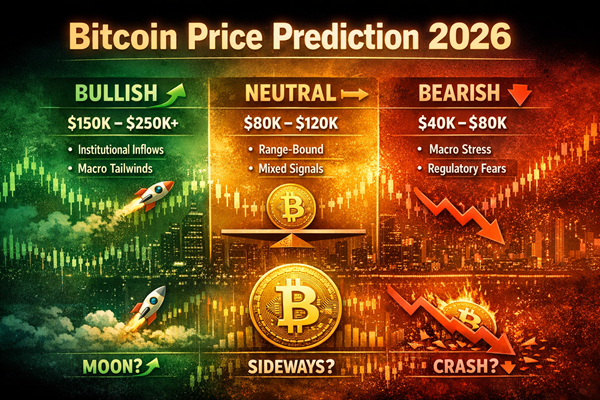
Price Target: $150,000 – $250,000+
This is the scenario everyone secretly hopes for. The charts break upward. Headlines scream new all-time highs. Twitter turns into laser eyes again.
And honestly? It’s not impossible.
In the bullish version of 2026, Bitcoin doesn’t just recover from its post-2025 cooling period. It accelerates.
Why This Could Happen
Institutional Adoption Gets Real
We’re not talking about retail hype. We’re talking about pension funds, asset managers, and serious capital.
Bitcoin ETFs already opened the door. But adoption doesn’t happen overnight. Big institutions move slowly. Committees debate. Risk teams hesitate. Then, suddenly, allocations start increasing.
Some forecasts already suggest serious upside:
- Standard Chartered and Bernstein point toward $150,000
- Firms like Bitwise and Grayscale believe new all-time highs are possible thanks to long-term structural adoption
If even a small percentage of global institutional capital treats Bitcoin like digital gold, demand could explode.
Macro Tailwinds Kick In
Markets don’t move in isolation.
If inflation fears return, if fiat currencies weaken, or if central banks ease monetary policy, Bitcoin often benefits. Investors start looking for alternatives. Scarce assets become attractive.
Bitcoin fits that narrative almost too perfectly.
A weaker dollar. More money printing. More distrust in traditional systems. All of that is fuel for BTC.
Scarcity Gets Loud Again
Around March 2026, Bitcoin crosses a psychological milestone: 20 million BTC mined.
That leaves fewer than 1 million coins left to ever exist. Ever.
Scarcity narratives matter in markets. They don’t move price by themselves, but they influence perception. And perception moves capital.
What Would Push This Bullish Scenario Forward?
- ETF inflows accelerating instead of slowing
- Clear, supportive regulation from major governments
- Strong macro environment for risk assets
- Retail enthusiasm returning alongside institutional buying
In this world, $150K doesn’t feel crazy. $200K doesn’t feel impossible. $250K becomes a stretch target – but still within imagination.
Scenario 2: Neutral – Bitcoin Goes Sideways
Price Target: $80,000 – $120,000
This is the scenario no one brags about on social media. But it might be the most realistic.
In the neutral path, Bitcoin doesn’t crash. It doesn’t explode either. It chops sideways. Months of consolidation. Frustrating price action. Boring headlines.
But markets need these phases.
Why This Happens
Post-Peak Hangover
Bitcoin cycles have a rhythm.
Big run. Big excitement. Then exhaustion. Then consolidation.
2025 delivered the fireworks. 2026 could be the year of digestion. Price moves between ranges. Traders fight over support and resistance. Long-term holders accumulate quietly.
That’s not weakness. That’s structure building.
Macro Signals Stay Mixed
Maybe inflation cools but doesn’t vanish.
..Maybe interest rates stabilize but don’t drop fast.
Maybe global growth limps instead of accelerates.
In that environment, capital doesn’t fully commit to risk assets. It hesitates. Bitcoin feels that hesitation too.
ETF Flows Stay Uneven
ETFs were expected to be a one-way rocket. Reality is more complex.
Some days bring inflows. Other weeks bring outflows. Institutions rebalance. Traders take profits. Momentum fades.
That doesn’t kill Bitcoin. It just slows it down.
What Neutral Looks Like in Practice
- Bitcoin trades around $90K–$110K for long stretches
- Big moves get rejected quickly
- Technical levels matter more than hype
- Volatility slowly compresses
This is the kind of market that feels dead… until it isn’t.
Why Sideways Markets Are Actually Powerful
Consolidation does three important things:
- It allows long-term investors to accumulate without panic
- It shakes out overleveraged traders
- It builds stronger support for the next big move
Boring markets often precede explosive ones.
Scenario 3: Bearish — Bitcoin Drops Hard
Price Target: $40,000 – $80,000 (or lower)
This is the scenario most people don’t like to talk about. But ignoring it is a mistake. Crypto punishes blind optimism.
In the bearish path, Bitcoin doesn’t just drift lower. It breaks key levels. Confidence fades. Narratives flip.
What Could Cause This?
Macro Turns Ugly
If global markets face serious stress — recession, liquidity crunch, geopolitical escalation — risk assets get hit.
When investors need cash, they sell what they can sell. Bitcoin, despite its “digital gold” story, still behaves like a risk asset in crises.
Models and historical comparisons suggest a deeper downturn could drag BTC toward $40K–$70K under sustained pressure.
Regulatory Shock
One harsh regulatory decision from a major economy can spook markets fast.
Restrictions on exchanges. ETF limitations. Tax changes. Harsh compliance rules. Even temporary fear can cause violent sell-offs.
Markets hate uncertainty more than bad news.
Technical Breakdown and Liquidations
Crypto markets run on leverage. Always have.
If Bitcoin loses critical support levels, liquidations cascade. Stop-losses trigger. Positions unwind. Selling feeds more selling.
That’s how you get sudden, brutal drops.
Some risk models even point to extreme downside scenarios closer to $50K or below if panic takes hold.
All Three Scenarios Compared
| Scenario | Price Range | What Drives It | Main Risk |
|---|---|---|---|
| Bullish | $150K–$250K+ | Institutional inflows, macro tailwinds, regulatory clarity | Policy shocks, liquidity tightening |
| Neutral | $80K–$120K | Balanced forces, consolidation, mixed sentiment | Lack of catalysts, slow adoption |
| Bearish | $40K–$80K | Macro stress, technical breakdown, fear | Panic selling, liquidity crunch |
What This Actually Means for Investors
Long-Term Holders
If you believe Bitcoin is a long-term store of value, 2026 is less about price targets and more about positioning.
Bullish scenario rewards patience massively.
Neutral scenario rewards discipline.
Bearish scenario rewards conviction (if you can stomach it).
Long-term investors usually survive by ignoring noise and managing risk.
Short-Term Traders
Range-bound markets are playgrounds for traders.
Neutral scenario especially favors:
- Support/resistance strategies
- Breakout trades
- Mean reversion setups
But it also punishes overconfidence. Chop destroys ego faster than crashes.
Risk-Averse Participants
If you’re cautious by nature, the bearish scenario must always be part of your planning.
Position sizing matters.
Stop-losses matter.
Diversification matters.
Crypto doesn’t forgive reckless exposure.
Bitcoin in 2026: One Asset, Three Futures
Bitcoin’s story in 2026 won’t be written by price charts alone.
It will be shaped by:
- Macro economics
- Institutional behavior
- Regulation
- Market psychology
- Human emotion (greed, fear, hope, denial)
That’s why three scenarios exist simultaneously. Markets don’t follow scripts. They follow probabilities.
Quick recap:
- Bullish: $150K–$250K+ driven by adoption and macro support
- Neutral: $80K–$120K driven by consolidation and balance
- Bearish: $40K–$80K driven by fear and breakdowns
None of these are fantasies. All are plausible.
The smart approach isn’t predicting which one will happen with certainty.
The smart approach is preparing for all three.
Bitcoin Price Prediction 2026 – FAQs
Will Bitcoin make a new all-time high in 2026?
It’s possible. Firms like Bitwise and Grayscale believe institutional adoption could push Bitcoin beyond previous highs. But it depends heavily on macro conditions and ETF inflows.
What is the most realistic Bitcoin price for 2026?
Many neutral forecasts place Bitcoin between $80,000 and $120,000 if neither strong bullish nor strong bearish forces dominate.
Could Bitcoin really fall below $50,000 again?
It’s unlikely under normal conditions, but not impossible. Severe macro stress, regulatory shock, or major market panic could push price toward that zone.
Are institutions still bullish on Bitcoin?
Overall, yes. Short-term flows fluctuate, but long-term institutional interest remains one of Bitcoin’s strongest structural supports.
Does the 2024 halving still matter in 2026?
Yes, but indirectly. Halving reduces supply growth, which historically supports higher prices over time. However, macro and adoption trends often matter more in the short term.
Bitcoin has never been about certainty. It’s always been about probability, psychology, and patience.
2026 will test all three.