
Consensus Protocols Explained – PoW vs PoS & Beyond
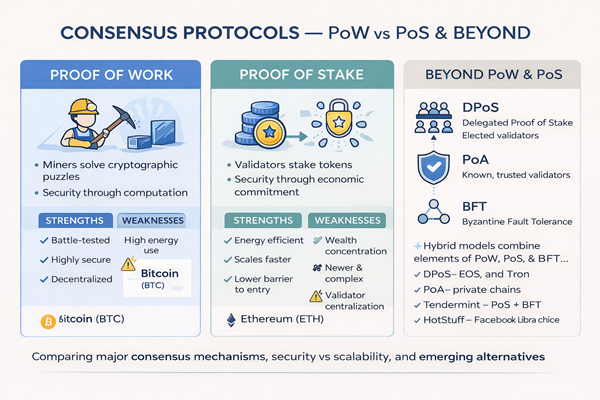
Lesson 9: Consensus Protocols – PoW, PoS & Beyond
Intent:
To explain what consensus is, compare major consensus protocol families (PoW, PoS, and others), and highlight their trade-offs in security, scalability, and decentralization.
Introduction – How Do Decentralized Systems Agree?
In traditional systems, agreement is simple:
- A central server decides what’s true.
But blockchains don’t have a central authority.
Thousands of independent nodes must agree on:
- Which transactions are valid
- Which block is the next official block
- What the current state of the ledger is
This shared agreement mechanism is called consensus – and it is the backbone of every blockchain network.
In this lesson, we’ll explore why consensus is needed, how it works, and how different protocols make different trade-offs.
What Is a Consensus Protocol?
A consensus protocol is a set of rules that allows distributed nodes to agree on a single version of truth, even when:
- Some nodes are offline
- Some messages are delayed
- Some participants may act maliciously
Consensus answers one fundamental question:
“Which block is the real one?”
Without consensus, a blockchain would quickly split into conflicting histories.Why Consensus Is Hard (The Core Problem)
Blockchain consensus must solve several challenges at once:
- No central leader
- Untrusted participants
- Network delays
- Potential attackers
This is related to classic problems in computer science like the Byzantine Generals Problem, where participants must coordinate despite unreliable communication and dishonest actors.
Consensus protocols are designed to survive these conditions.
Proof of Work (PoW)
What Is Proof of Work?
Proof of Work requires participants (miners) to solve computationally expensive puzzles to propose new blocks.
- The puzzle is hard to solve
- But easy for others to verify
This “work” proves the miner invested real-world resources (electricity and hardware).
How PoW Works (Simplified)
- Miners collect transactions into a block
- They repeatedly hash the block with different values
- The first miner to find a valid hash wins
- The block is broadcast and verified by the network
- The chain with the most accumulated work becomes canonical
Strengths of PoW
- Extremely secure and battle-tested
- Highly resistant to attacks
- Simple and robust design
- Proven at global scale (Bitcoin)
Weaknesses of PoW
- High energy consumption
- Slower transaction throughput
- Hardware centralization risk
- Environmental concerns
PoW prioritizes security and decentralization over speed.
Proof of Stake (PoS)
What Is Proof of Stake?
Proof of Stake replaces computational work with economic stake.
Validators:
- Lock up (stake) tokens
- Are selected to propose and validate blocks
- Earn rewards or face penalties (slashing)
Security comes from financial risk, not electricity.
How PoS Works (Simplified)
- Validators stake tokens
- The protocol selects a validator to propose a block
- Other validators attest to its validity
- Honest behavior earns rewards
- Dishonest behavior results in slashing
Strengths of PoS
- Far more energy efficient
- Faster finality
- Lower hardware requirements
- Easier scalability
Weaknesses of PoS
- Wealth concentration risk
- More complex protocol design
- Newer and less battle-tested
- Governance complexity
PoS optimizes for efficiency and scalability while maintaining security through incentives.
Beyond PoW & PoS – Other Consensus Families
Delegated Proof of Stake (DPoS)
- Token holders vote for a small set of validators
- Fast and efficient
- More centralized
- Used by EOS, TRON
Proof of Authority (PoA)
- Validators are known, trusted identities
- Very fast and cheap
- Low decentralization
- Common in private or enterprise blockchains
Byzantine Fault Tolerant (BFT) Protocols
Examples:
- PBFT
- Tendermint
- HotStuff
Characteristics:
- Fast finality
- Strong consistency
- Limited scalability
- Used in permissioned or hybrid chains
Hybrid & Emerging Models
Modern blockchains often combine approaches:
- PoS + BFT (Ethereum, Cosmos)
- PoW + finality gadgets
- DAG-based consensus
- Rollup-centric consensus layers
Innovation in consensus is ongoing.
Consensus Trade-Offs – The Reality
No consensus protocol is perfect.
| Goal | Trade-Off |
|---|---|
| Security | Speed |
| Decentralization | Efficiency |
| Scalability | Complexity |
| Simplicity | Flexibility |
This is closely tied to the Blockchain Trilemma:
Security, Decentralization, Scalability – pick two (optimize carefully).
Real-World Analogy
- PoW: A competition where effort proves honesty
- PoS: A security deposit that punishes cheating
- BFT: A committee vote with strict rules
Each works best in different environments.
Why Consensus Is the Heart of Blockchain
Consensus ensures:
- One shared history
- Resistance to fraud
- Trustless coordination
- Global agreement without authority
Without consensus, blockchain is just a database.
Key Takeaway
Consensus protocols define:
- Who can add blocks
- How truth is decided
- How secure the network is
PoW, PoS, and newer models each make deliberate trade-offs – there is no universally “best” consensus, only the right one for a given purpose.
Next Lesson Preview
👉 Lesson 10: Incentives & Game Theory – Why Honest Behavior Wins
We’ll explore how rewards, penalties, and rational incentives keep decentralized networks secure.