
How Cryptocurrency Gets Its Value – Tokenomics 101
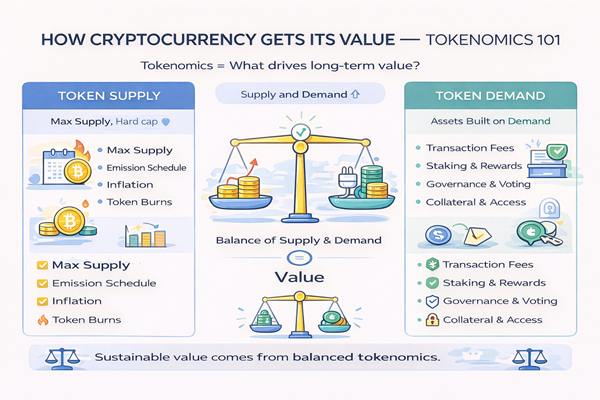
How Cryptocurrency Gets Its Value – Tokenomics 101
Intent: Explain how supply schedules, inflation, token burns, and economic design determine long-term cryptocurrency value.
Introduction – Price Is Not the Same as Value
Crypto prices move every second.
Value is built over years.
To understand why some cryptocurrencies survive while others fade, you need to understand tokenomics – the economic rules that govern how a token is created, distributed, and sustained.
Tokenomics answers one key question:
Why should this token be worth anything in the long run?
What Is Tokenomics?
Tokenomics is the study of a cryptocurrency’s economic design, including:
- How many tokens exist
- How new tokens are created
- How tokens are distributed
- How demand is generated
- How supply is reduced or controlled
Bad tokenomics can kill even great technology.
Good tokenomics can bootstrap entire ecosystems.
The Supply Side – How Many Tokens Exist?
Max Supply
Some cryptocurrencies have a hard supply cap.
Example:
- Bitcoin → 21 million BTC
A fixed supply:
- Creates digital scarcity
- Increases predictability
- Reduces inflation risk
But scarcity alone doesn’t create value.
Infinite or Elastic Supply
Other cryptocurrencies:
- Have no fixed cap
- Adjust supply over time
Why?
- To fund security
- To incentivize participation
- To stabilize the network
What matters is controlled issuance, not zero issuance.
Emission Schedules – How Tokens Enter Circulation
An emission schedule defines:
- How fast new tokens are created
- Who receives them
- When issuance decreases or ends
Examples:
- Bitcoin halvings
- Gradual PoS issuance
- Time-based unlocks
Predictable issuance builds market confidence.
Inflation – The Hidden Cost
Inflation occurs when:
- New tokens are created faster than demand grows
Effects:
- Dilutes existing holders
- Pressures price downward
- Funds network operations
Inflation is not always bad-but uncontrolled inflation is.
Healthy inflation:
- Secures the network
- Incentivizes validators
- Supports growth
Token Burns – Reducing Supply
A token burn permanently removes tokens from circulation.
Why burn tokens?
- Counter inflation
- Reward holders
- Create deflationary pressure
- Align usage with value
Examples:
- Fee-based burns
- Scheduled burns
- Buyback-and-burn models
Burns turn usage into scarcity.
Demand Side – Why Do People Need the Token?
A token needs real demand drivers.
Common demand sources:
- Transaction fees
- Staking requirements
- Governance voting
- Collateral usage
- Access to services
Speculation creates volatility.
Utility creates sustainability.
Velocity – How Fast Tokens Move
Velocity measures:
How often a token changes hands
High velocity:
- Weak value capture
- Lower price support
Low velocity:
- Strong holding incentives
- Better value retention
Tokenomics often aim to slow velocity through staking, locking, or rewards.
Distribution – Who Gets the Tokens?
Poor distribution can break a project.
Key questions:
- How much goes to founders?
- How much to early investors?
- How much to the community?
- Are tokens locked or vested?
Fair, transparent distribution builds trust.
Incentives – Aligning Behavior
Tokenomics uses incentives to:
- Reward honest participation
- Penalize bad behavior
- Encourage long-term commitment
Staking, slashing, and rewards are all economic tools.
Good tokenomics makes:
The best behavior also the most profitable behavior
Common Tokenomic Models
| Model | Purpose |
|---|---|
| Fixed supply | Scarcity & store of value |
| Inflationary | Security & participation |
| Deflationary | Value capture |
| Hybrid | Balance growth & stability |
Most modern projects use hybrid models.
Why Tokenomics Matters More Than Tech
Technology can be copied.
Economic design cannot be easily fixed later.
Many failed projects had:
- Great ideas
- Poor token economics
Tokenomics determines whether a network:
- Thrives
- Stagnates
- Or collapses
Key Takeaway
A cryptocurrency gets its value from:
- How supply is controlled
- How demand is created
- How incentives are aligned
Tokenomics is not about hype —
it’s about sustainable economic design.
Next Lesson Preview
👉 Stablecoins – How Crypto Mimics Fiat Stability
We’ll explore how stablecoins work, their backing models, and why they power DeFi.
