Keys vs Addresses Understanding the Technical Difference
Keys vs Addresses – The Technical Difference
Intent: Explain what private keys, public keys, and addresses are, how they are derived, and how they are used in practice.
Introduction – The Confusion That Breaks Beginners
Many newcomers think:
- Their wallet is their crypto
- Their address is their key
- Their private key is stored “on the blockchain”
All of that is wrong and dangerous.
To use crypto safely, you must understand the technical difference between keys and addresses.
This lesson breaks it down step by step, without unnecessary math.
The Three Core Components
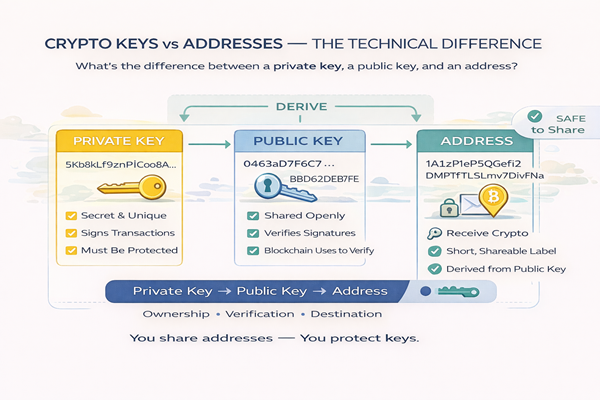
Every blockchain account is built on three cryptographic elements:
- Private Key
- Public Key
- Address
Each has a different role.
Private Key – The Source of Ownership
A private key is a large random number.
It is:
- Secret
- Unique
- The ultimate proof of ownership
Whoever controls the private key controls the funds.
Key Facts
- Generated randomly
- Never shared
- Used to sign transactions
- Not stored on the blockchain
If someone gets your private key, they don’t need your permission.
Public Key – The Verifier
A public key is mathematically derived from the private key.
It is:
- Safe to share
- Used to verify signatures
- Part of the transaction validation process
Important Relationship
Private Key → Public Key (one-way)
You can derive the public key from the private key,
but you cannot reverse it.
Address – The Destination Label
An address is a shortened, hashed version of the public key.
It is:
- What you share to receive funds
- What appears on the blockchain
- Optimized for readability and error detection
Think of an address as a mailbox label, not the lock.
The Derivation Flow (Simplified)
Here’s the actual technical flow:
Private Key
↓
Public Key
↓
Address
Each step adds:
- Abstraction
- Safety
- Convenience
Why We Don’t Use Public Keys Directly
Blockchains use addresses instead of raw public keys because:
- Addresses are shorter
- Addresses reduce attack surface
- Addresses include checksum protection
- Addresses improve usability
Public keys are revealed only when spending, not when receiving.
Practical Example – Sending Crypto
Let’s walk through a real transaction.
Step 1: Receiving Funds
- You share your address
- Sender sends funds to that address
- Blockchain records the transaction
Step 2: Spending Funds
- Wallet uses your private key to sign the transaction
- Network uses your public key to verify the signature
- Funds move if verification succeeds
At no point is your private key exposed.
Seed Phrases – Where Do They Fit?
A seed phrase (12–24 words) is a human-readable way to store:
- Your private key
- Or more commonly, a master key
From this master key, wallets derive:
- Multiple private keys
- Multiple addresses
This is called hierarchical deterministic (HD) wallets.
One phrase → many accounts.
Why Addresses Can Change
You might notice wallets generate:
- New addresses for each transaction
This improves:
- Privacy
- Security
- Transaction traceability resistance
All addresses still map back to your original keys.
Common Misunderstandings (and Fixes)
“My crypto is in my wallet”
Crypto lives on the blockchain
“My address is my private key”
Address is derived from public key
“Losing my phone means losing crypto”
Seed phrase restores everything
Security Rules You Must Follow
- Never share private keys
- Never share seed phrases
- Addresses are safe to share
- Verify address formats carefully
- Back up seed phrases offline
Most hacks exploit confusion, not cryptography.
Why This Difference Matters
Understanding keys vs addresses helps you:
- Avoid scams
- Use wallets confidently
- Recover funds safely
- Understand how signatures work
Crypto security begins with key literacy.
Key Takeaway
- Private key = ownership
- Public key = verification
- Address = destination
You share addresses.
You protect keys.
Next Lesson Preview
👉 Transaction Fees & Gas – Why Blockchain Isn’t Free
We’ll explore gas, fee markets, and why transactions cost money.