What Are Cryptocurrencies? Use Cases & Value Drivers
What Are Cryptocurrencies? -Use Cases & Value Drivers
Intent: Explain what cryptocurrencies are, how they’re used in the real world, and where their value comes from: utility, scarcity, and network effects.
Introduction – More Than “Digital Money”
At first glance, cryptocurrencies look like internet money.
But that description misses the bigger picture.
Cryptocurrencies are:
- Economic incentives
- Network fuel
- Governance tools
- Value-transfer mechanisms
They exist not just to store value-but to coordinate behavior in decentralized systems.
What Is a Cryptocurrency?
A cryptocurrency is a digital asset that:
- Lives on a blockchain
- Is secured by cryptography
- Can be transferred without intermediaries
- Follows protocol-defined rules
Unlike traditional money:
- No central bank issues it
- No authority controls it
- Ownership is verified mathematically
Cryptocurrencies vs Traditional Money
| Feature | Fiat Money | Cryptocurrency |
|---|---|---|
| Issuer | Central bank | Protocol |
| Supply | Adjustable | Rule-based |
| Settlement | Bank-led | Peer-to-peer |
| Access | Permissioned | Permissionless |
| Control | Centralized | Decentralized |
Cryptocurrencies replace institutional trust with cryptographic trust.
Core Use Cases of Cryptocurrencies
Cryptocurrencies exist because they do useful things.
Let’s look at the main categories.
1. Medium of Exchange
Cryptocurrencies enable:
- Peer-to-peer payments
- Cross-border transfers
- 24/7 settlement
- Low-friction remittances
No banks.
No intermediaries.
No permission required.
Bitcoin is the most famous example.
2. Store of Value
Some cryptocurrencies are designed to:
- Preserve purchasing power
- Resist inflation
- Be scarce and durable
Bitcoin’s fixed supply makes it attractive as digital gold.
Value comes from:
- Predictable issuance
- Strong security
- Global acceptance
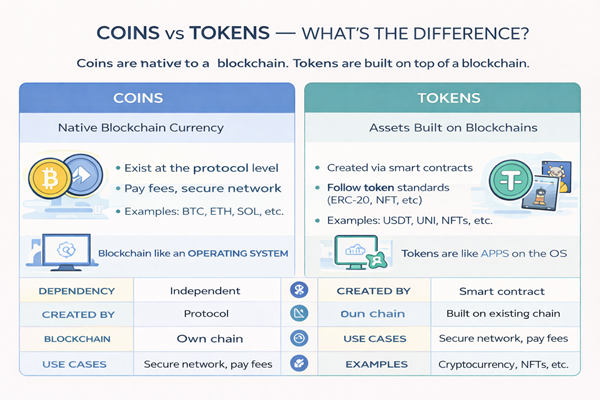
3. Network Fuel (Utility Tokens)
Many cryptocurrencies act as fuel for blockchain networks.
Examples:
- ETH pays for computation
- SOL pays for transactions
- MATIC pays for scaling operations
No fuel = no execution.
Utility creates constant demand.
4. Governance & Coordination
Some cryptocurrencies give holders:
- Voting rights
- Parameter control
- Upgrade influence
These tokens allow decentralized communities to make decisions collectively.
Value comes from control and participation, not just price.
5. Access & Collateral
Cryptocurrencies are used as:
- Collateral in DeFi
- Access tokens for platforms
- Staking assets for security
In many systems, holding the token is the ticket to participation.
Where Does Crypto Value Come From?
This is the most important question.
Cryptocurrency value is not random-it comes from three main drivers.
1. Utility – What Can You Do With It?
If a token:
- Pays fees
- Secures a network
- Unlocks functionality
- Enables applications
Then it has intrinsic utility.
More usage = more demand.
2. Scarcity – How Much Exists?
Scarcity is enforced by code, not policy.
Examples:
- Bitcoin’s 21 million cap
- Emission schedules
- Burning mechanisms
Predictable supply builds trust.
Scarcity without utility is speculation.
Utility without scarcity struggles to hold value.
3. Network Effects – Who Else Uses It?
A cryptocurrency becomes more valuable as:
- More users join
- More developers build
- More businesses accept it
Network effects create:
- Liquidity
- Adoption
- Self-reinforcing growth
Bitcoin and Ethereum dominate because of their ecosystems-not just technology.
The Value Equation (Mental Model)
Think of crypto value as:
Value = Utility × Scarcity × Network Effects
If any one is zero, value collapses.
Speculation vs Fundamentals
Markets may be speculative short-term, but long-term value depends on:
- Real usage
- Sustainable incentives
- Strong communities
Price follows adoption, not hype.
Why Cryptocurrencies Matter
Cryptocurrencies:
- Remove gatekeepers
- Enable global participation
- Create programmable money
- Align incentives at scale
They are economic engines, not just assets.
Key Takeaway
Cryptocurrencies derive value because they:
- Do useful work
- Are scarce by design
- Grow stronger as more people use them
They combine technology, economics, and game theory into one system.
Next Lesson Preview
👉 Stablecoins – Crypto Without Volatility
We’ll explore how stablecoins work, how they’re backed, and why they power the crypto economy.