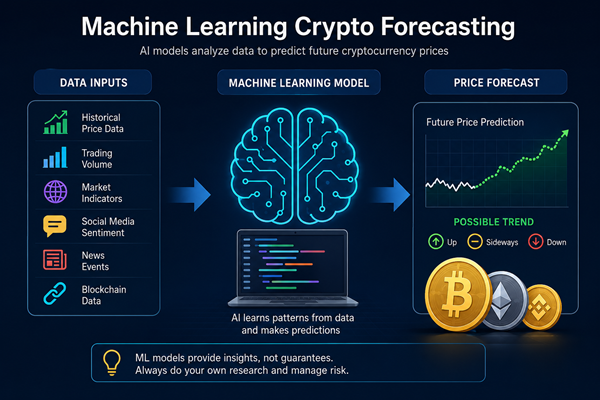
Best Crypto Prediction Models: AI Models for Price Forecasting
Best Crypto Prediction Models: How AI and Data Analytics Forecast Cryptocurrency Prices
Cryptocurrency markets are highly dynamic, with prices changing every minute due to market demand, investor sentiment, global events, and technological developments. Because of this volatility, traders, investors, and analysts use advanced crypto prediction models to understand market trends and estimate possible future price movements.
The best crypto prediction models combine historical price data, technical indicators, blockchain activity, market sentiment, and artificial intelligence to generate forecasts. While no model can predict cryptocurrency prices with complete certainty, advanced forecasting systems can help identify patterns and provide valuable market insights.
At Coin-Predictions.com, we analyze cryptocurrency markets using data-driven approaches that combine statistical methods, machine learning techniques, and market analysis to create meaningful price forecasts.
What Are Crypto Prediction Models?
Crypto prediction models are analytical systems that use mathematical algorithms, historical data, and market information to estimate future cryptocurrency price movements.
These models analyze factors such as:
- Historical price trends
- Trading volume
- Market volatility
- Investor sentiment
- Blockchain activity
- Cryptocurrency fundamentals
- Economic conditions
The purpose of a prediction model is not to guarantee future prices but to calculate possible outcomes based on available information.
Why Are Crypto Prediction Models Important?
Cryptocurrency markets are influenced by thousands of factors. Human traders cannot manually analyze all available information quickly enough.
Prediction models help by:
- Processing large amounts of market data
- Identifying hidden patterns
- Detecting market trends
- Reducing emotional decision-making
- Providing probability-based forecasts
Professional traders, research platforms, and cryptocurrency analysts increasingly rely on automated forecasting systems to improve their market analysis.
1. Machine Learning Models
Machine learning (ML) models are among the most popular approaches for cryptocurrency price prediction.
These models learn from historical market data and identify patterns that may indicate future price movements.
Common machine learning algorithms include:
Linear Regression Models
Linear regression attempts to identify relationships between different variables and cryptocurrency prices.
It can analyze:
- Historical prices
- Trading volume
- Market indicators
Advantages:
- Simple and easy to interpret
- Useful for identifying basic trends
Limitations:
- Cannot easily handle complex market behavior
- Less effective during extreme volatility
Random Forest Models
Random Forest is a machine learning algorithm that combines multiple decision trees to make predictions.
It can analyze multiple factors simultaneously, including:
- Price changes
- Trading patterns
- Market indicators
- External signals
Advantages:
- Handles large datasets
- Reduces prediction errors
- Works well with complex information
Support Vector Machines (SVM)
Support Vector Machines classify market conditions and identify possible price directions.
They are often used for:
- Trend prediction
- Market classification
- Price movement analysis
SVM models can be effective when market patterns are clearly defined.
2. Deep Learning Models
Deep learning models use artificial neural networks to analyze complex relationships within cryptocurrency data.
These models are inspired by the structure of the human brain and can process large amounts of information.
Long Short-Term Memory (LSTM) Networks
LSTM models are widely used for cryptocurrency forecasting because they are designed to analyze time-series data.
They can identify:
- Previous price patterns
- Long-term trends
- Market cycles
LSTM models are especially useful because cryptocurrency prices depend heavily on historical sequences.
Advantages:
- Good at analyzing time-based patterns
- Can remember important historical information
- Suitable for price forecasting
Limitations:
- Requires large amounts of quality data
- Computationally expensive
Artificial Neural Networks (ANN)
Artificial Neural Networks analyze relationships between multiple market variables.
They can process:
- Price history
- Technical indicators
- Trading volume
- Sentiment data
ANN models are flexible and can adapt as new market data becomes available.
3. Time-Series Forecasting Models
Time-series models analyze historical price movements to predict future trends.
These models are commonly used in financial forecasting.
ARIMA Model
ARIMA (AutoRegressive Integrated Moving Average) is a statistical model used for forecasting future values based on historical patterns.
It is useful for:
- Short-term forecasting
- Trend analysis
- Market behavior studies
Advantages:
- Well-established statistical method
- Easy to understand
Limitations:
- Less effective in highly unpredictable markets
Exponential Smoothing Models
These models give more importance to recent price data when creating forecasts.
They are useful for identifying:
- Recent market trends
- Short-term price movements
4. Hybrid Crypto Prediction Models
Hybrid models combine multiple forecasting techniques to improve prediction performance.
For example:
- Machine learning + technical analysis
- AI models + sentiment analysis
- Blockchain data + statistical forecasting
Hybrid systems can analyze different aspects of the cryptocurrency market simultaneously.
Many modern crypto prediction platforms use hybrid approaches because cryptocurrency prices are affected by multiple interconnected factors.
5. AI-Based Sentiment Analysis Models
Cryptocurrency markets are strongly influenced by public opinion and investor emotions.
Sentiment analysis models use artificial intelligence to analyze:
- Social media posts
- News articles
- Online discussions
- Search trends
Positive sentiment may indicate increasing market interest, while negative sentiment may signal potential selling pressure.
AI sentiment models help prediction systems understand market psychology.
6. On-Chain Prediction Models
Blockchain data provides valuable information that traditional markets do not offer.
On-chain prediction models analyze:
- Wallet movements
- Exchange deposits and withdrawals
- Transaction volume
- Active addresses
- Network activity
Examples:
- Large cryptocurrency transfers to exchanges may indicate possible selling pressure.
- Increasing wallet activity may suggest growing adoption.
On-chain analysis adds another layer of information to crypto forecasting.
7. Reinforcement Learning Models
Reinforcement learning is an advanced AI technique where algorithms learn through experience and feedback.
In cryptocurrency markets, reinforcement learning models can:
- Simulate trading strategies
- Optimize decision-making
- Adapt to changing market conditions
These models are still developing but have significant potential for future crypto forecasting systems.
Which Crypto Prediction Model Is the Most Accurate?
There is no single crypto prediction model that is always the most accurate.
The effectiveness of a model depends on:
- Quality of data
- Cryptocurrency being analyzed
- Market conditions
- Prediction timeframe
- Algorithm design
For example:
- LSTM models may perform well for time-series forecasting.
- Sentiment models may help during news-driven market movements.
- On-chain models may provide valuable blockchain insights.
- Hybrid AI models may perform better by combining multiple signals.
The strongest prediction systems usually combine several methods instead of relying on one model.
How Coin-Predictions.com Uses Crypto Prediction Models
At Coin-Predictions.com, cryptocurrency forecasts are developed using a combination of analytical approaches.
Our prediction framework considers:
- Historical cryptocurrency price data
- Market trends
- Technical indicators
- Statistical forecasting methods
- AI-driven analysis
- Sentiment signals
- Blockchain-related information
By combining multiple data sources, we aim to provide users with comprehensive cryptocurrency market insights.
Our goal is to help users understand possible market scenarios through transparent, data-driven analysis.
Limitations of Crypto Prediction Models
Even the best prediction models have limitations.
Challenges include:
Market Volatility
Sudden price movements can reduce prediction accuracy.
Unexpected Events
Regulatory changes, security incidents, and major announcements can affect prices instantly.
Limited Historical Data
Cryptocurrency markets have a shorter history compared with traditional financial markets.
Changing Market Behavior
Patterns that worked previously may not always work in future market conditions.
Therefore, crypto prediction models should be used as research tools rather than guaranteed forecasting systems.
Future of Cryptocurrency Prediction Models
The future of crypto forecasting will likely involve more advanced artificial intelligence, improved blockchain analytics, and real-time market monitoring.
Future prediction systems may include:
- Advanced deep learning algorithms
- More accurate sentiment analysis
- Real-time blockchain intelligence
- Improved market simulation models
As technology improves, crypto prediction models will become more powerful and useful for investors and analysts.
Final Thoughts: Choosing the Best Crypto Prediction Models
The best crypto prediction models combine artificial intelligence, statistical analysis, market data, and blockchain insights to identify possible future trends.
Machine learning, deep learning, LSTM networks, sentiment analysis, and hybrid models all provide valuable approaches to cryptocurrency forecasting.
However, no model can eliminate uncertainty from crypto markets. The most effective approach is using prediction models together with proper research, risk management, and market understanding.
At Coin-Predictions.com, we use data-driven cryptocurrency analysis to help users explore market trends and make more informed decisions in the rapidly evolving world of digital assets.
Learn more
How Are Cryptocurrency Prices Predicted?
Are Crypto Price Predictions Accurate?