
AI Crypto Prediction Explained: How AI Forecasts Crypto Prices
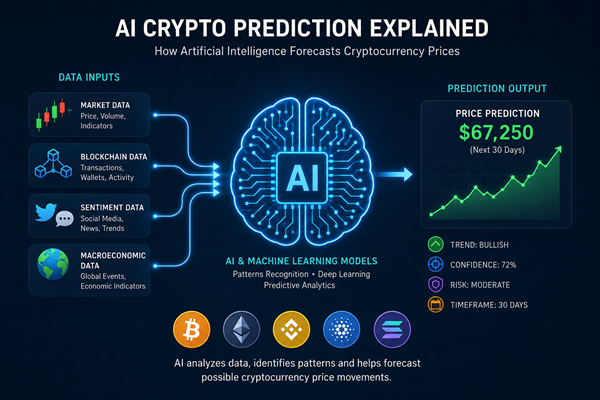
AI Crypto Prediction Explained: How Artificial Intelligence Forecasts Cryptocurrency Prices
Introduction
Cryptocurrency markets are known for their extreme volatility, rapid price movements, and unpredictable behavior. Bitcoin, Ethereum, and thousands of altcoins can experience significant price changes within hours due to market sentiment, news events, regulations, economic conditions, and investor behavior.
To better understand these movements, many analysts and platforms are now using Artificial Intelligence (AI) for crypto price prediction. AI-powered models analyze massive amounts of market data, identify hidden patterns, and generate forecasts that help traders and investors make more informed decisions.
But how does AI actually predict cryptocurrency prices? Can artificial intelligence accurately forecast the future of crypto markets? What data does it use, and what are its limitations?
This guide explains AI crypto prediction, how it works, the technologies behind it, and how investors can use AI-based forecasts effectively.
What Is AI Crypto Prediction?
AI crypto prediction refers to the use of artificial intelligence technologies, machine learning algorithms, and data analysis techniques to forecast future cryptocurrency price movements.
Unlike traditional analysis methods that rely mainly on human interpretation of charts and indicators, AI systems can process millions of data points simultaneously and discover complex relationships that may not be obvious to human analysts.
AI crypto prediction models analyze factors such as:
- Historical cryptocurrency prices
- Trading volume
- Market trends
- Technical indicators
- Social media sentiment
- Blockchain activity
- News and global events
- Investor behavior patterns
The goal of AI prediction is not to guarantee future prices but to provide data-driven probability estimates about possible market movements.
How Does AI Predict Cryptocurrency Prices?
AI crypto prediction works by combining multiple technologies, including machine learning, deep learning, natural language processing, and statistical modeling.
The general process involves several steps:
1. Collecting Cryptocurrency Market Data
AI models first gather large amounts of historical and real-time information.
Common data sources include:
- Price history
- Open, high, low, close (OHLC) data
- Trading volume
- Market capitalization
- Exchange activity
- Blockchain transactions
- Wallet movements
- Social media discussions
- News articles
For example, an AI model analyzing Bitcoin may study years of price movements along with millions of market signals to identify recurring patterns.
2. Identifying Market Patterns Using Machine Learning
Machine learning allows computers to learn from historical data without being manually programmed for every situation.
AI algorithms analyze previous market behavior and search for relationships between different factors.
For example:
- When trading volume increases, does price usually rise?
- How does Bitcoin react after major news events?
- Does social media sentiment influence short-term price movement?
- Are there repeating market cycles?
The AI model improves its predictions by learning from past successes and mistakes.
3. Using Deep Learning Networks
Advanced AI crypto prediction systems often use deep learning models inspired by the human brain.
These models can analyze complex market patterns over time.
Popular deep learning techniques include:
Neural Networks
Neural networks identify relationships between multiple market variables and price changes.
They can detect patterns such as:
- Trend reversals
- Momentum shifts
- Market cycles
Long Short-Term Memory Networks (LSTM)
LSTM models are designed to analyze time-series data, making them useful for cryptocurrency forecasting.
They can remember previous market conditions and use that information to predict possible future movements.
For example:
If Bitcoin historically reacts in a certain way after a major price drop, an LSTM model may recognize similar conditions in current markets.
4. Sentiment Analysis With Natural Language Processing (NLP)
Cryptocurrency prices are heavily influenced by public opinion and investor emotions.
AI systems use Natural Language Processing (NLP) to analyze:
- News articles
- Twitter/X posts
- Reddit discussions
- Crypto forums
- Search trends
The AI determines whether market sentiment is:
- Positive (bullish)
- Negative (bearish)
- Neutral
For example:
A sudden increase in positive Bitcoin discussions combined with rising trading volume may indicate increased market interest.
5. Generating Crypto Price Forecasts
After analyzing all available data, AI models generate predictions based on probabilities.
A forecast may include:
- Expected price range
- Possible support and resistance levels
- Market trend direction
- Risk indicators
- Short-term and long-term scenarios
For example:
An AI model may predict:
“Bitcoin has a higher probability of moving upward over the next 30 days based on historical patterns, increasing trading volume, and positive market sentiment.”
However, this does not mean the price movement is guaranteed.
Types of AI Crypto Prediction Models
Different AI techniques are used depending on the prediction goal.
1. Machine Learning Models
Traditional machine learning algorithms analyze historical data to identify relationships.
Common models include:
- Random Forest
- Support Vector Machines (SVM)
- Gradient Boosting
- Regression models
These are often used for trend classification and price forecasting.
2. Deep Learning Models
Deep learning models handle large and complex datasets.
Examples include:
- Neural networks
- LSTM networks
- Transformer models
They are commonly used for advanced cryptocurrency forecasting systems.
3. Hybrid AI Models
Many modern crypto prediction platforms combine multiple methods.
A hybrid model may combine:
- Technical analysis
- Machine learning
- Sentiment analysis
- Blockchain data
This approach provides a more complete market view.
What Data Does AI Use for Crypto Predictions?
AI crypto prediction systems rely on multiple types of data.
Technical Market Data
Includes:
- Price movements
- Trading volume
- Moving averages
- RSI indicators
- MACD signals
- Market volatility
Blockchain Data
Blockchain analysis provides information such as:
- Number of active addresses
- Transaction volume
- Exchange inflows and outflows
- Large wallet movements
Social Media Data
AI tracks public discussions to measure market sentiment.
Examples:
- Increasing Bitcoin searches
- Growing crypto community discussions
- Fear or excitement among investors
Macroeconomic Data
Crypto markets are also affected by:
- Interest rates
- Inflation
- Stock market performance
- Global economic events
Advantages of AI Crypto Prediction
AI offers several benefits compared with traditional analysis.
1. Faster Data Processing
Humans cannot manually analyze millions of market signals. AI systems can process large datasets within seconds.
2. Reduced Emotional Bias
Human traders often make decisions based on fear and greed.
AI models analyze data objectively without emotional influence.
3. Pattern Recognition
AI can identify complex relationships that may be difficult for humans to detect.
4. Continuous Market Monitoring
AI systems can monitor cryptocurrency markets 24/7.
Limitations of AI Crypto Predictions
Although AI is powerful, it cannot predict cryptocurrency prices with complete certainty.
1. Cryptocurrency Markets Are Highly Unpredictable
Unexpected events can dramatically affect prices:
- Government regulations
- Exchange failures
- Security breaches
- Economic crises
AI models cannot always predict sudden events.
2. Historical Data Does Not Guarantee Future Results
AI learns from past market behavior, but cryptocurrency markets constantly change.
A pattern that worked previously may not work in the future.
3. Poor Data Can Produce Poor Predictions
AI accuracy depends on the quality of data.
Incorrect, incomplete, or delayed information can reduce prediction reliability.
4. Market Manipulation
Crypto markets can be influenced by:
- Large investors (“whales”)
- Coordinated trading activity
- Artificial hype campaigns
These events are difficult for AI models to predict.
Can AI Predict Bitcoin and Crypto Prices Accurately?
AI can improve cryptocurrency forecasting by identifying patterns and analyzing large amounts of information, but it cannot accurately predict every price movement.
The most reliable AI prediction systems combine:
- Historical price analysis
- Market indicators
- Blockchain activity
- Sentiment analysis
- Risk assessment
AI should be viewed as a decision-support tool rather than a guaranteed prediction machine.
Successful investors usually combine AI insights with:
- Fundamental analysis
- Risk management
- Market research
- Personal investment strategies
How Investors Can Use AI Crypto Predictions
AI forecasts can help investors:
Identify Market Trends
AI can highlight whether market conditions appear bullish, bearish, or uncertain.
Discover Opportunities
Investors can use AI signals to find cryptocurrencies showing potential momentum.
Manage Risk
AI models can identify volatility and possible downside risks.
Improve Decision Making
Instead of relying only on emotions, investors can use data-backed insights.
The Future of AI in Cryptocurrency Forecasting
Artificial intelligence will likely play an increasingly important role in cryptocurrency analysis.
Future AI systems may include:
- More advanced predictive models
- Real-time blockchain analysis
- Better sentiment understanding
- Automated portfolio management
- AI-powered trading assistants
As cryptocurrency markets become more complex, AI will help investors process information faster and make more informed decisions.
Final Thoughts: Understanding AI Crypto Prediction
AI crypto prediction combines artificial intelligence, machine learning, and market data analysis to estimate possible cryptocurrency price movements.
While AI can identify patterns, analyze huge datasets, and improve forecasting, it cannot eliminate the uncertainty of crypto markets.
The best approach is to use AI predictions as one part of a broader investment strategy. Combining AI insights with research, risk management, and market understanding can help investors make smarter decisions in the rapidly changing cryptocurrency ecosystem.
Read More
How are cryptocurrency prices predicted?
Are crypto price predictions accurate?