How to Get Crypto Price Prediction From AI: Can AI Predict Crypto?

How to Get Crypto Price Prediction From AI: Can AI Really Predict Crypto Prices in 2026, 2027, 2028 & the Future?
Can AI predict cryptocurrency prices? This question has become one of the most searched topics among crypto investors.
Instead of spending hours looking at charts, economic data, Bitcoin dominance, ETF flows, social-media sentiment and cryptocurrency news, traders can now ask artificial intelligence systems to analyze thousands of pieces of information and produce a potential market outlook.
Tools such as ChatGPT, Claude, Google Gemini, Grok, Perplexity, Microsoft Copilot, DeepSeek, Meta AI, Mistral and Qwen can help investors analyze cryptocurrency markets in different ways.
At the same time, dedicated crypto forecasting platforms such as CoinCodex, CoinMarketCap Price Estimates and CryptoPredictions.com provide algorithmic or aggregated cryptocurrency forecasts.
But there is an important distinction:
AI can analyze information and generate probability-based crypto forecasts. It cannot know the future price of Bitcoin, Ethereum or any other cryptocurrency with certainty.
That distinction becomes even more important when asking AI to predict crypto prices for 2026, 2027, 2028, 2030 or beyond.
A one-week forecast and a four-year forecast are completely different problems.
This guide explains how to get a crypto price prediction from AI, which AI tools can help, how to write better prompts, how to compare multiple AI predictions, and how to use AI forecasts without confusing them with guaranteed future prices.
Quick Answer: Can AI Really Predict Crypto Prices?
Yes, but only in a limited and probabilistic sense.
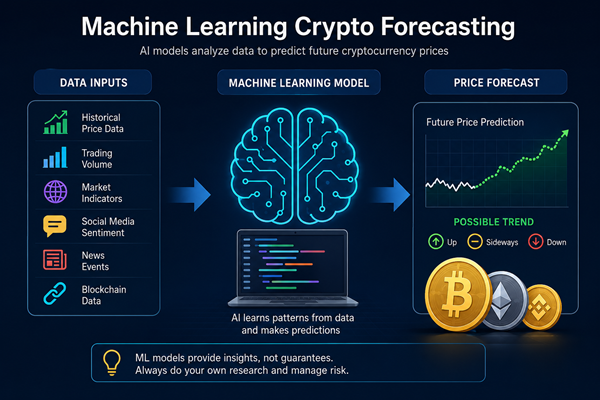
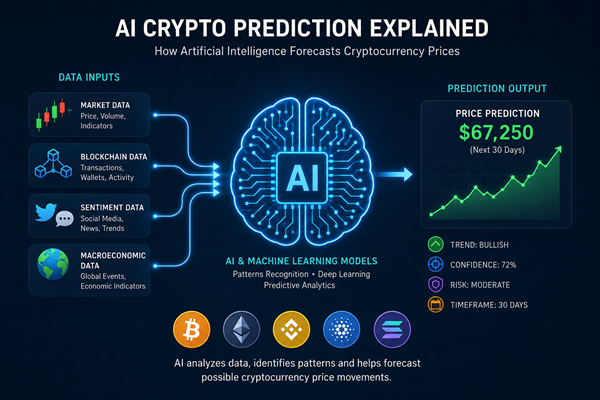
AI can identify patterns in historical prices, trading volume, technical indicators, news, sentiment, macroeconomic data and other variables.
Machine-learning models can also be trained specifically for financial forecasting.
However, cryptocurrency markets are highly volatile, non-stationary and affected by unexpected events.
Recent research continues to describe short-term Bitcoin price prediction as a difficult open problem because Bitcoin has fat-tailed returns, changing market regimes and price discovery influenced by social discourse.
So an AI prediction such as:
“Bitcoin could reach $150,000 in 2027”
should be interpreted as a scenario, not a promise.
The best use of AI is therefore not:
“Tell me exactly what Bitcoin will be worth.”
A better question is:
“Analyze the available evidence and give me bullish, base-case and bearish scenarios, the assumptions behind each scenario, and the conditions that would invalidate them.”
That produces a much more useful crypto forecast.
What Is AI Crypto Price Prediction?
AI crypto price prediction is the use of artificial intelligence, machine learning, statistical models or large language models to estimate the future price or direction of a cryptocurrency.
Depending on the system, the model may analyze:
- Historical price
- Trading volume
- Market capitalization
- Moving averages
- RSI
- MACD
- Volatility
- Support and resistance
- Bitcoin dominance
- On-chain activity
- Exchange flows
- ETF flows
- Funding rates
- Open interest
- Liquidations
- Social-media sentiment
- News
- Interest rates
- Inflation
- U.S. dollar strength
- Liquidity conditions
- Regulatory developments
- Token supply
- Network activity
A sophisticated crypto prediction model may combine many of these variables.
However, a general-purpose chatbot such as ChatGPT is not automatically equivalent to a purpose-built quantitative forecasting model.
That distinction is critical.
AI Chatbots vs. AI Crypto Prediction Models
There are two broad categories of AI tools investors should understand.
1. General-Purpose AI
Examples include:
- ChatGPT
- Claude
- Google Gemini
- Grok
- Perplexity
- Microsoft Copilot
- DeepSeek
- Meta AI
- Mistral
- Qwen
- Llama-based assistants
These systems are excellent at:
- Research
- Summarization
- Reasoning
- Comparing scenarios
- Explaining technical indicators
- Analyzing news
- Creating trading frameworks
- Writing code
- Building forecasting models
But they are not necessarily trained specifically to predict cryptocurrency prices.
2. Dedicated Crypto Forecasting Systems
Examples include:
- CoinCodex
- CryptoPredictions.com
- CoinMarketCap Price Estimates
- Quantitative machine-learning models
- Proprietary trading algorithms
- Custom Python forecasting systems
- Neural-network models
- Time-series models
These systems may be specifically designed around cryptocurrency price data or prediction workflows.
CoinCodex, for example, publishes algorithmic cryptocurrency price forecasts, while CoinMarketCap’s Price Estimates feature aggregates user-submitted estimates and applies statistical processing such as outlier filtering.
CryptoPredictions.com publishes daily, monthly and yearly forecasts for cryptocurrencies and displays projections across years including 2026–2030.
The important lesson is:
“AI” does not describe one single prediction technology.
How to Get Crypto Price Prediction From AI
If you want to use AI to forecast Bitcoin, Ethereum, XRP, Solana, Dogecoin or another cryptocurrency, don’t simply type:
“Predict Bitcoin price.”
You will probably receive a vague answer.
Instead, provide the AI with a structured research task.
Step 1: Choose the Cryptocurrency
For example:
- Bitcoin (BTC)
- Ethereum (ETH)
- XRP
- Solana (SOL)
- Cardano (ADA)
- Dogecoin (DOGE)
- BNB
- Chainlink (LINK)
- Avalanche (AVAX)
- Polkadot (DOT)
Step 2: Choose the Prediction Timeframe
This is extremely important.
Ask AI for:
Short-term
- Next 24 hours
- Next 7 days
- Next month
Medium-term
- 3 months
- 6 months
- End of 2026
Long-term
- 2027
- 2028
- 2030
- 2035
The longer the timeframe, the greater the uncertainty.
A model may have useful information for a seven-day technical forecast but considerably less confidence about a price several years into the future.
Step 3: Give AI Current Market Data
This is where many AI crypto forecasts fail.
If you ask an AI model to predict Bitcoin without giving it current market information, the answer may rely on incomplete or outdated context.
A better analysis provides:
- Current BTC price
- 7-day performance
- 30-day performance
- Trading volume
- Market cap
- BTC dominance
- RSI
- Moving averages
- Support/resistance
- ETF flows
- Funding rates
- Open interest
- Recent major news
- Fed expectations
- Dollar index
- Treasury yields
For real-time research, use an AI system with current web access or provide fresh market data yourself.
For example, Grok currently advertises real-time web and X search, allowing it to analyze current news and social trends rather than relying only on older training data.
OpenAI also recommends using web search or deep research in ChatGPT for deeper real-time financial analysis.
Step 4: Ask for Multiple Scenarios
This is one of the most important improvements you can make.
Don’t ask:
“What will Bitcoin be worth in 2027?”
Ask:
“Give me a bullish, base-case and bearish Bitcoin price scenario for 2027. For each scenario, explain the assumptions, probability range, major catalysts, risks and invalidation conditions.”
Now the AI is forced to think in terms of uncertainty.
For example:
| Scenario | What AI Should Analyze |
|---|---|
| Bullish | ETF inflows, liquidity, adoption, supply constraints |
| Base case | Moderate adoption and normal market conditions |
| Bearish | Recession, regulation, liquidity contraction, risk-off markets |
This is much more useful than one dramatic price target.
The Best AI Tools for Crypto Price Prediction
There is no universally “best” AI for cryptocurrency forecasting.
Different AI systems are useful for different parts of the research process.
1. ChatGPT for Crypto Price Prediction
ChatGPT can be extremely useful for building a structured crypto-analysis workflow.
It can help with:
- Technical-analysis explanations
- Fundamental analysis
- Market research
- Scenario modeling
- Historical comparisons
- Python-based forecasting
- Data analysis
- Prompt-based research
- Comparing different prediction models
- Summarizing crypto news
OpenAI’s current finance guidance describes ChatGPT as useful for financial analysis, market analysis and planning, while explicitly stating that it is not a fiduciary, registered investment adviser or broker-dealer.
Best ChatGPT prompt for crypto prediction
Try:
“Analyze Bitcoin using current market data. Examine price trend, volume, RSI, moving averages, support and resistance, ETF flows, Bitcoin dominance, macroeconomic conditions, Federal Reserve expectations, U.S. dollar strength, market sentiment and major news. Then produce bullish, base-case and bearish price scenarios for the next 30 days, December 2026, 2027 and 2028. Do not present any scenario as guaranteed. Explain the assumptions and invalidation conditions for every forecast.”
That is much stronger than:
“Will Bitcoin go up?”
2. Google Gemini for Crypto Forecasting
Google Gemini can be useful for research-heavy crypto analysis, particularly when you want to combine multiple information sources and ask for comparisons.
Use Gemini to investigate:
- Crypto news
- Market narratives
- Historical trends
- Macro conditions
- Blockchain developments
- Regulatory changes
- Competing forecasts
A useful Gemini prompt is:
“Analyze the factors that could influence Ethereum between now and 2028. Separate technological, fundamental, macroeconomic and market-structure factors. Then create bullish, base-case and bearish scenarios.”
Gemini should be treated as an analytical assistant rather than a crystal ball.
3. Claude for Crypto Price Analysis
Claude is particularly useful when you want a detailed analytical framework.
You can give Claude:
- CSV price data
- Technical indicators
- Research reports
- Tokenomics documents
- News summaries
- Historical market data
Then ask it to identify relationships and risks.
A useful prompt:
“Review this Bitcoin dataset and identify the strongest relationships between volatility, volume, momentum and subsequent price movement. Separate correlation from causation and identify possible sources of overfitting.”
That is a better use of Claude than simply asking for a random future price.
4. Grok for Real-Time Crypto Sentiment
Grok has a particularly interesting role in crypto research because xAI currently advertises real-time web search and live X integration.
That matters because cryptocurrency markets are heavily influenced by:
- Breaking news
- Social sentiment
- Influencer commentary
- Regulatory announcements
- Exchange announcements
- Market rumors
- Sudden geopolitical developments
Grok can therefore be useful as a real-time sentiment and news layer.
Try:
“Analyze current Bitcoin sentiment across X and recent news. Identify whether sentiment is bullish, neutral or bearish. Separate genuine market-moving information from speculation and explain which developments could materially change BTC price.”
Do not treat social sentiment as proof that a price will rise.
5. Perplexity AI for Crypto Research
Perplexity can be particularly useful when you want an AI-assisted research process with source discovery.
Instead of asking:
“Predict Bitcoin.”
Try:
“Find the latest credible research on Bitcoin’s 2026–2028 outlook. Compare institutional forecasts, ETF trends, macroeconomic assumptions and on-chain data. Cite the sources and identify disagreements between analysts.”
This approach is useful because the quality of a prediction depends heavily on the quality and freshness of the underlying information.
6. Microsoft Copilot
Microsoft Copilot can also be used as a general research assistant for cryptocurrency analysis.
Use it to:
- Summarize financial information
- Compare forecasts
- Analyze market narratives
- Build research tables
- Examine macroeconomic relationships
Again, it should be treated as an analytical tool rather than a guaranteed prediction engine.
7. DeepSeek
DeepSeek can be useful for technical and quantitative tasks, particularly when paired with structured datasets and code.
For example, you could ask DeepSeek to:
“Build a Python time-series forecasting framework for Bitcoin using historical OHLCV data. Compare ARIMA, XGBoost and LSTM approaches and explain the validation methodology.”
This is fundamentally different from asking a chatbot to guess a future price.
8. Meta AI
Meta AI can be useful for general research, summarization and market discussions.
It can help you organize information about:
- Bitcoin
- Ethereum
- Altcoins
- Crypto narratives
- Social sentiment
- Blockchain developments
But again, the quality of the prediction depends on the underlying data and methodology.
9. Mistral AI
Mistral AI can be used for analytical workflows, summarization and coding-related tasks.
For quantitative crypto research, you can provide historical datasets and ask the model to help create:
- Feature sets
- Forecasting logic
- Technical-analysis scripts
- Backtesting frameworks
10. Qwen
Qwen can also be incorporated into a multi-model crypto research workflow.
Instead of trusting one AI, ask Qwen to independently analyze the same dataset and compare its assumptions with ChatGPT, Claude, Gemini and other models.
This creates an important concept:
AI Consensus
If five independent models analyze the same information and reach similar conclusions, that does not prove the forecast will be correct.
But if they disagree dramatically, that disagreement itself is useful information.
11. Llama-Based AI Models
Llama and other open-weight model ecosystems can be useful for developers who want to build their own crypto prediction systems.
A developer can combine an LLM with:
- Historical price APIs
- On-chain data
- News feeds
- Sentiment models
- Technical indicators
- Machine-learning models
This is potentially much more powerful than asking a generic chatbot for a number.
12. CoinCodex
CoinCodex is different from a general AI chatbot.
It provides cryptocurrency price predictions through an algorithmic forecasting system.
Its prediction pages publish projections across multiple future periods and cryptocurrencies.
This makes it useful as a comparison benchmark.
For example:
ChatGPT forecast
vs.
Claude forecast
vs.
Gemini forecast
vs.
Grok forecast
vs.
CoinCodex algorithmic forecast
A large difference between the forecasts tells you that uncertainty is high.
13. CoinMarketCap Price Estimates
CoinMarketCap offers a different approach.
Its Price Estimates feature aggregates user-submitted predictions rather than simply presenting them as a single AI-generated number.
CoinMarketCap says it requires more than 30 submissions before publishing statistics for a month-end, and it uses techniques including 1.5× IQR outlier filtering. It also calculates historical estimate accuracy by comparing the estimate average with the month-end volume-weighted average price.
This is an important lesson:
A prediction becomes more useful when you can evaluate how it performed historically.
14. CryptoPredictions.com
CryptoPredictions.com provides daily, monthly and yearly cryptocurrency forecasts.
Its prediction pages can extend across:
- 2026
- 2027
- 2028
- 2029
- 2030
The site explicitly states that its forecasts should not be considered financial advice.
This makes it useful for researching how long-term algorithmic forecasting systems construct future scenarios.
But a 2028 prediction should never be treated with the same confidence as a seven-day forecast.
Can AI Predict Bitcoin Price in 2026?
This is where the question becomes more interesting.
A 2026 Bitcoin forecast can incorporate:
- Current market cycle
- Post-halving dynamics
- ETF flows
- Institutional adoption
- Interest rates
- Liquidity
- Bitcoin supply
- Miner economics
- On-chain activity
- Regulation
- Stablecoin growth
- Market sentiment
AI can combine these variables into scenarios.
But even a sophisticated AI model cannot know exactly what will happen to:
- Global liquidity
- Interest rates
- Regulation
- ETF demand
- Geopolitical conditions
- Exchange failures
- Black-swan events
Therefore:
2026 predictions can be useful as scenario analysis, not certainty.
Can AI Predict Crypto Prices in 2027?
The uncertainty increases.
By 2027, today’s assumptions about:
- Regulation
- Institutional adoption
- Interest rates
- ETF flows
- Tokenization
- Stablecoins
- DeFi
- Layer-2 adoption
may be completely different.
Therefore, an AI forecasting Bitcoin for 2027 should ideally provide a range rather than one exact number.
For example:
Bull Case
Bitcoin experiences strong institutional adoption, expanding liquidity and continued demand.
Base Case
Bitcoin grows with moderate adoption and normal cyclical volatility.
Bear Case
Liquidity tightens, regulation becomes restrictive and crypto experiences a prolonged risk-off cycle.
Can AI Predict Crypto Prices in 2028?
A 2028 prediction is even more uncertain.
Why?
Because a four-year forecast has many more variables.
For Bitcoin, AI would need to consider:
- Future halving effects
- Global monetary policy
- Institutional adoption
- ETF structure
- Mining economics
- Network security
- Competition
- Regulation
- Global liquidity
- Technological changes
- Investor behavior
The farther into the future you forecast, the more important scenario analysis becomes.
A 2028 prediction should therefore look something like:
| Scenario | 2028 Outlook |
|---|---|
| Bearish | Weak adoption + restrictive liquidity |
| Base | Continued adoption + normal volatility |
| Bullish | Strong institutional demand + favorable liquidity |
| Extreme Bull | Major global monetary/institutional adoption |
The exact price should be treated as secondary to the assumptions.
What About Crypto Prices in 2030 and Beyond?
This is where AI predictions become particularly speculative.
An AI can create a mathematical projection to 2030.
It can extrapolate historical growth.
It can model supply and demand.
It can build Monte Carlo simulations.
But the further the forecast extends, the greater the uncertainty.
A 2030 crypto prediction is therefore best interpreted as:
“What could happen if these assumptions remain approximately true?”
not:
“This is what the coin will definitely be worth.”
Why AI Cannot Reliably Predict the Exact Crypto Price
There are several fundamental reasons.
1. Crypto Markets Are Non-Stationary
The relationships that worked in one market cycle may fail in another.
For example:
A technical indicator may work during a trending bull market but perform poorly during a sideways market.
AI models must therefore adapt to changing regimes.
Recent academic research specifically emphasizes regime changes and finds that incorporating sentiment differently during stable and volatile Bitcoin regimes can improve model calibration, while still showing that prediction remains difficult.
2. Black-Swan Events
AI cannot reliably predict an event that has not happened before.
Examples include:
- Exchange failures
- Unexpected wars
- Regulatory bans
- Major hacks
- Stablecoin failures
- Sudden liquidity crises
- Unexpected ETF decisions
- Major technological vulnerabilities
A single event can invalidate a previously reasonable forecast.
3. Human Behavior
Crypto prices are influenced by human emotions.
Fear.
Greed.
FOMO.
Panic.
Euphoria.
Capitulation.
AI can analyze sentiment, but predicting exactly when millions of humans will suddenly change their behavior is extremely difficult.
4. Market Manipulation
Smaller cryptocurrencies can experience:
- Whale movements
- Low liquidity
- Pump-and-dump behavior
- Wash trading
- Sudden exchange listings
- Large liquidations
These events can produce price movements that historical models struggle to predict.
5. Data Quality
Garbage in, garbage out.
If your AI receives:
- Old prices
- Incorrect market caps
- Missing volume
- Incorrect token supply
- Outdated news
- Wrong technical indicators
the resulting prediction can look intelligent while being fundamentally wrong.
This is one of the biggest dangers of AI-generated financial analysis.
6. Overfitting
A machine-learning model can become extremely good at explaining the past and terrible at predicting the future.
This is called overfitting.
For example, a model might learn that Bitcoin historically behaved a certain way after a specific technical pattern.
But if the market structure changes, the pattern may stop working.
This is why proper:
- Train/test splitting
- Walk-forward validation
- Out-of-sample testing
- Backtesting
- Cross-validation
are critical.
The Most Important Rule: Never Ask One AI
If you want a stronger AI crypto forecast, use multiple models.
For example:
Model 1
ChatGPT
Model 2
Claude
Model 3
Gemini
Model 4
Grok
Model 5
Perplexity
Model 6
DeepSeek
Model 7
CoinCodex algorithmic forecast
Model 8
CoinMarketCap community estimates
Then compare the results.
How to Build an AI Crypto Prediction Consensus
Suppose you want to forecast Bitcoin.
Ask each AI:
“Using current market information, estimate Bitcoin’s price range for December 2026. Provide bullish, base-case and bearish scenarios. Identify the three strongest assumptions and the biggest risk that could invalidate your forecast. Do not give a guaranteed prediction.”
Then create a table:
| AI / Model | Bullish | Base Case | Bearish |
|---|---|---|---|
| ChatGPT | — | — | — |
| Claude | — | — | — |
| Gemini | — | — | — |
| Grok | — | — | — |
| Perplexity | — | — | — |
| DeepSeek | — | — | — |
| CoinCodex | — | — | — |
| CoinMarketCap Estimates | — | — | — |
The objective is not to find the AI that gives the highest number.
The objective is to discover:
Where does the evidence converge?
A Better AI Crypto Prediction Prompt
Here is a reusable prompt you can give to ChatGPT, Claude, Gemini, Grok, Perplexity, DeepSeek or another capable AI:
“Act as a quantitative cryptocurrency market analyst. Analyze [COIN] using the latest available market data. Evaluate historical price trends, trading volume, volatility, RSI, MACD, moving averages, support/resistance, market capitalization, token supply, Bitcoin dominance, on-chain activity, exchange flows, derivatives open interest, funding rates, ETF flows where relevant, macroeconomic conditions, Federal Reserve policy, U.S. dollar strength, liquidity, regulatory developments, news and market sentiment.
Create three scenarios: bearish, base case and bullish. Provide estimated price ranges rather than a single guaranteed price. For each scenario, explain the assumptions, catalysts, probability level, risks and invalidation conditions. Then provide separate outlooks for 7 days, 30 days, the end of 2026, 2027 and 2028. Clearly distinguish current data from assumptions and identify information that may be uncertain or outdated.”
This is far more useful than:
“Predict [COIN] price.”
How to Make AI Crypto Predictions More Accurate
You cannot make them perfectly accurate.
But you can make the process better.
Use fresh data
Current data is essential.
Use multiple models
Don’t depend on one AI.
Use ranges
Avoid false precision.
Include macroeconomic variables
Crypto doesn’t trade in isolation.
Include sentiment
Especially for short-term forecasting.
Backtest predictions
Measure whether the methodology actually worked historically.
Track predictions over time
Don’t delete failed forecasts.
Record assumptions
A prediction without assumptions is difficult to evaluate.
AI Prediction Accuracy: How Should You Measure It?
If an AI predicts:
BTC = $100,000
and Bitcoin reaches:
$99,000
that prediction may have been useful.
But if another AI predicts:
BTC = $105,000
and Bitcoin reaches:
$100,000
the second model may actually have produced the better forecast depending on the evaluation method.
Therefore, use quantitative metrics.
Mean Absolute Error
Measures average prediction error.
Root Mean Square Error
Penalizes larger errors more heavily.
Mean Absolute Percentage Error
Measures error relative to actual price.
Directional Accuracy
Measures whether the model correctly predicted:
Up or Down
Sharpe Ratio
Useful when evaluating a trading strategy rather than simply a price prediction.
But even these metrics must be interpreted carefully.
A model that performs well during one bull market may fail during a bear market.
AI Price Prediction vs Technical Analysis
AI does not replace technical analysis.
It can enhance it.
Traditional technical analysis might examine:
- RSI
- MACD
- Bollinger Bands
- Moving averages
- Fibonacci levels
- Support/resistance
- Volume
- Market structure
AI can combine these indicators and explain relationships.
For example:
“BTC is above the 200-day moving average, RSI is rising but not yet overbought, volume is increasing and resistance is approaching.”
AI can turn those observations into scenarios.
But the final forecast remains uncertain.
AI Price Prediction vs Fundamental Analysis
For crypto, fundamental analysis can include:
- Token supply
- Network usage
- Developer activity
- Fees
- Active addresses
- TVL
- Stablecoin activity
- Institutional adoption
- Token unlocks
- Governance
- Revenue
- Ecosystem growth
AI can combine these factors with technical data.
This creates a more comprehensive model than price history alone.
AI + Sentiment Analysis
This is becoming particularly important.
AI can analyze:
- X posts
- Reddit discussions
- Telegram discussions
- News headlines
- Google Trends
- Crypto forums
- YouTube transcripts
and classify sentiment as:
Bullish
Neutral
Bearish
But sentiment should not be treated as a direct trading signal.
Extreme bullish sentiment can occur near market tops.
Extreme fear can occur near market bottoms.
Therefore:
Sentiment is a variable, not a guarantee.
AI + On-Chain Data
For Bitcoin and other major cryptocurrencies, on-chain information can add another layer.
Examples include:
- Exchange inflows
- Exchange outflows
- Whale activity
- Active addresses
- Realized price
- MVRV
- SOPR
- Network activity
An advanced crypto forecasting system could combine:
Price + technical indicators + on-chain data + sentiment + macroeconomic data
This is significantly more sophisticated than simply asking a chatbot for a prediction.
AI Crypto Prediction for Altcoins
AI can be particularly useful when researching thousands of cryptocurrencies.
However, altcoin forecasting is usually harder than Bitcoin forecasting.
Why?
Smaller cryptocurrencies can have:
- Lower liquidity
- Greater volatility
- Less historical data
- Higher manipulation risk
- Token unlocks
- Concentrated ownership
- Rapidly changing narratives
Therefore, an AI prediction for a small-cap token should generally carry a much larger uncertainty range than a Bitcoin prediction.
Can AI Predict Meme Coins?
AI can analyze meme coins.
It can examine:
- Social sentiment
- Trading volume
- Liquidity
- Whale activity
- Social-media trends
- Exchange listings
- Token distribution
But meme coins are particularly difficult to predict.
A viral post can change the market in minutes.
Therefore:
AI may identify momentum, but it cannot reliably predict virality.
Can AI Predict Bitcoin’s Next Bull Run?
AI can estimate conditions associated with previous Bitcoin bull markets.
It can analyze:
- Halving cycles
- Liquidity
- ETF demand
- Institutional adoption
- Stablecoin supply
- Bitcoin dominance
- Market sentiment
But Bitcoin’s next cycle does not have to behave exactly like previous cycles.
History provides evidence.
It does not provide a guaranteed script.
Can AI Predict Ethereum in 2027 or 2028?
AI can create Ethereum scenarios using:
- Network activity
- ETH supply
- Staking
- Layer-2 activity
- DeFi usage
- Institutional adoption
- ETF flows
- Ethereum upgrades
- Competition from other blockchains
The most useful output is a range of possible outcomes rather than one precise number.
The Biggest Mistake People Make With AI Crypto Predictions
The biggest mistake is:
Treating a confident answer as an accurate answer.
AI can write:
“Bitcoin will reach $250,000 in 2028.”
The sentence can sound extremely convincing.
But confidence in language is not the same thing as statistical confidence.
Recent research and practical tests of AI financial advice continue to highlight the need to verify AI-generated financial information because models can produce incorrect or incomplete information.
This is why every AI prediction should be challenged.
Ask:
What evidence supports this?
What assumptions are being made?
What could make this forecast wrong?
What data would change the prediction?
Those questions are more valuable than asking for a bigger price target.
Can AI Really Predict Crypto Prices in the Future?
The honest answer is:
AI can become better at forecasting probabilities.
It cannot become a perfect crystal ball.
As AI improves, future forecasting systems may incorporate:
- Real-time market data
- On-chain intelligence
- Social sentiment
- Economic data
- News
- Derivatives
- Order books
- Wallet behavior
- Machine learning
- Reinforcement learning
- Multi-agent systems
This could make forecasts more useful.
But markets will remain adaptive.
When traders discover a profitable prediction pattern, they may trade on it, causing the pattern to weaken.
This creates a fundamental challenge:
The market changes because people respond to the market.
The Future of AI Crypto Prediction
The next generation of crypto forecasting is likely to move beyond simple chatbots.
Instead, imagine an AI system that continuously monitors:
Bitcoin price
↓
Order book
↓
ETF flows
↓
On-chain data
↓
Whale wallets
↓
Funding rates
↓
Liquidations
↓
X sentiment
↓
News
↓
Fed policy
↓
Global liquidity
↓
Technical indicators
↓
Machine-learning forecast
↓
Bull / Base / Bear probabilities
That is much closer to what a professional AI-assisted market research system could look like.
AI Crypto Price Prediction: The Best Strategy
If your goal is to get the best possible crypto price forecast from AI, don’t use one AI.
Use a multi-layer approach.
Layer 1 – Market Data
Collect:
- Price
- Volume
- Market cap
- Volatility
- Technical indicators
Layer 2 – Fundamental Data
Analyze:
- Tokenomics
- Network activity
- Adoption
- Development
- Institutional demand
Layer 3 – On-Chain Data
Analyze:
- Whale activity
- Exchange flows
- Active addresses
- Realized metrics
Layer 4 – Sentiment
Analyze:
- X
- News
- Google Trends
- Crypto communities
Layer 5 – AI Models
Ask:
- ChatGPT
- Claude
- Gemini
- Grok
- Perplexity
- DeepSeek
- Copilot
- Mistral
- Qwen
- Llama-based models
Layer 6 – Algorithmic Forecasts
Compare:
- CoinCodex
- CryptoPredictions.com
- CoinMarketCap estimates
- Your own machine-learning model
Layer 7 – Human Review
Finally ask:
Does the prediction make sense?
This final step is extremely important.
Best AI Crypto Prediction Workflow for 2026
Here is a practical workflow investors can use today.
Step 1
Choose the cryptocurrency.
Step 2
Collect current market data.
Step 3
Ask ChatGPT for a fundamental and technical analysis.
Step 4
Ask Claude for an independent risk assessment.
Step 5
Ask Gemini to investigate broader market and macroeconomic factors.
Step 6
Use Grok to examine current news and social sentiment.
Step 7
Use Perplexity to find and verify sources.
Step 8
Use DeepSeek or another coding-oriented model to examine quantitative data.
Step 9
Compare the results with CoinCodex and other algorithmic prediction platforms.
Step 10
Create a final:
Bear Case + Base Case + Bull Case
forecast.
This approach is much stronger than relying on one AI-generated price.
So, Which AI Is Best for Crypto Price Prediction?
There isn’t one universal winner.
A practical way to think about them is:
| AI / Tool | Best Use in Crypto Research |
|---|---|
| ChatGPT | Overall analysis, reasoning, data analysis |
| Claude | Detailed analysis and risk evaluation |
| Gemini | Research and broader information analysis |
| Grok | Real-time news and X/social sentiment |
| Perplexity | Source-driven research |
| DeepSeek | Quantitative and coding workflows |
| Microsoft Copilot | General research and analysis |
| Meta AI | General AI research |
| Mistral | Analysis and technical workflows |
| Qwen | Independent model comparison |
| Llama | Custom/open model development |
| CoinCodex | Algorithmic crypto forecasts |
| CoinMarketCap | Aggregated community price estimates |
| CryptoPredictions.com | Long-range algorithmic forecasts |
The key point is:
Don’t ask which AI is always right. Ask which AI is best suited to each part of the research process.
AI Crypto Price Prediction: 2026, 2027 and 2028
The further into the future we look, the wider the uncertainty should become.
2026
AI can analyze current market conditions relatively well if supplied with fresh data.
Forecast confidence: Moderate
2027
More uncertainty enters through regulation, liquidity, adoption and market cycles.
Forecast confidence: Low to moderate
2028
The number of unknown variables increases substantially.
Forecast confidence: Low
2030+
Long-term price targets should primarily be considered scenario analysis.
Forecast confidence: Very low
This does not make long-term forecasts useless.
It means they should be treated as conditional scenarios rather than predictions of a known future.
How Coin-Predictions.com Can Use AI Crypto Predictions
For readers researching cryptocurrency forecasts, AI should be used as one layer of analysis, not the entire forecasting system.
A stronger crypto prediction platform can combine:
Historical data
Technical analysis
Fundamental analysis
Market sentiment
On-chain metrics
AI models
Algorithmic forecasts
Human interpretation
That combination can provide readers with a more transparent picture of possible future outcomes.
Instead of saying:
“Bitcoin will reach $200,000.”
a high-quality prediction page should explain:
Bull Case: What conditions could push Bitcoin toward the upside target?
Base Case: What outcome is most consistent with current evidence?
Bear Case: What could cause a major decline?
Invalidation: What new information would make the forecast wrong?
This is a much more useful way to present cryptocurrency predictions.
Final Verdict: Can AI Really Predict Crypto Prices?
AI can predict cryptocurrency prices in the sense that it can estimate possible future outcomes from data and assumptions.
But AI cannot know the exact future price.
The strongest AI crypto forecasting approach combines:
- Current market data
- Historical price data
- Technical analysis
- Fundamental analysis
- On-chain metrics
- Market sentiment
- Macroeconomic data
- Multiple AI models
- Algorithmic forecasting
- Backtesting
- Scenario analysis
ChatGPT, Claude, Gemini, Grok, Perplexity, DeepSeek, Copilot, Meta AI, Mistral, Qwen and Llama-based systems can all contribute different capabilities.
Dedicated platforms such as CoinCodex, CoinMarketCap’s Price Estimates and CryptoPredictions.com can provide additional forecasting benchmarks.
But none should be treated as a guaranteed crystal ball.
The smartest way to use AI is not to ask:
“What will Bitcoin’s price be in 2028?”
Instead ask:
“What are the most likely bullish, base-case and bearish outcomes for Bitcoin in 2028, what assumptions support each scenario, and what evidence would prove the forecast wrong?”
That is the difference between AI guessing a price and AI-assisted cryptocurrency research.
Frequently Asked Questions
Can ChatGPT predict crypto prices?
ChatGPT can analyze cryptocurrency data, explain market factors and generate scenario-based forecasts. However, it cannot guarantee future cryptocurrency prices and should not be treated as a financial adviser. OpenAI explicitly states that ChatGPT is not a registered investment adviser or broker-dealer.
Which AI is best for crypto price prediction?
There is no universally best AI. ChatGPT, Claude, Gemini, Grok, Perplexity and DeepSeek can each be useful for different parts of crypto analysis. A multi-AI approach is generally more informative than relying on one model.
Can AI predict Bitcoin in 2026?
AI can create probability-based Bitcoin scenarios for 2026 using current market, macroeconomic, technical and fundamental information. However, unexpected events can invalidate any forecast.
Can AI predict Bitcoin in 2027?
Yes, AI can create 2027 scenarios, but uncertainty is higher than for a short-term forecast because more assumptions are required.
Can AI predict crypto prices in 2028?
AI can produce 2028 projections, but these should be treated as long-term scenarios rather than precise forecasts. Changes in regulation, adoption, liquidity, technology and investor behavior can materially change the outcome.
Can AI predict altcoin prices?
AI can analyze altcoins using price, volume, liquidity, tokenomics, sentiment and other data. However, smaller altcoins are generally more difficult to forecast because of lower liquidity, limited historical data and greater volatility.
Is AI crypto prediction accurate?
Accuracy varies enormously between models, assets, timeframes and market regimes. A model that performs well during one market cycle can fail during another. Historical backtesting and out-of-sample testing are therefore essential.
Can I use multiple AI models to predict crypto?
Yes. Comparing ChatGPT, Claude, Gemini, Grok, Perplexity, DeepSeek and dedicated forecasting systems can provide a broader view. The objective should be to identify agreement, disagreement and the assumptions behind each forecast.
Should I invest based only on an AI prediction?
No. AI-generated predictions should be treated as research inputs rather than guaranteed investment signals. Always verify the underlying data and consider the risks before making financial decisions.
Conclusion
Artificial intelligence is changing the way people research cryptocurrency.
In the past, an investor might have needed to manually study charts, news, market sentiment, economic reports and blockchain data.
Today, AI can help organize and analyze much of that information in minutes.
But AI is not a crystal ball.
The future of cryptocurrency prices will still be determined by millions of interacting variables, including supply and demand, liquidity, regulation, technology, institutional adoption, investor psychology and unexpected events.
The best approach in 2026 is therefore not to search for an AI that claims to know the exact price of Bitcoin in 2027 or 2028.
Instead, build a multi-model AI forecasting process.
Use ChatGPT for structured analysis.
Use Claude for detailed reasoning.
Use Gemini for research.
Use Grok for real-time news and social sentiment.
Use Perplexity for source discovery.
Use DeepSeek for quantitative workflows.
Use Copilot, Meta AI, Mistral, Qwen and Llama-based systems for additional perspectives and custom workflows.
Then compare those results with algorithmic forecasting platforms such as CoinCodex, CoinMarketCap Price Estimates and CryptoPredictions.com.
Finally, turn all of that information into bullish, base-case and bearish scenarios.
That is how AI can genuinely become useful for cryptocurrency price prediction.
Not by pretending to know the future — but by helping investors understand the range of futures that could realistically happen.
Disclaimer: This article is for educational and informational purposes only and does not constitute investment, financial, legal or tax advice. Cryptocurrency prices are highly volatile, and AI-generated forecasts can be inaccurate, incomplete or based on changing information. Always verify current market data, research the underlying cryptocurrency and consider your own risk tolerance before making investment decisions.