Buy USDT Without Personal Information: Privacy Guide
Buy USDT Without Personal Information: A Privacy-Focused Guide
Learn how to buy USDT with greater privacy, what “no personal information” really means, KYC requirements, risks, P2P options, and safer alternatives.
Buy USDT Without Personal Information: What You Need to Know
USDT (Tether) is one of the most widely used stablecoins in the cryptocurrency market. Because USDT is designed to maintain a value close to the U.S. dollar, many people use it for trading, transferring funds between exchanges, holding dollar-denominated value, and moving money between different crypto platforms.
A common search among privacy-conscious crypto users is:
“Can I buy USDT without providing personal information?”
The short answer is: sometimes, but it depends on where and how you purchase it.
There is an important difference between buying USDT with minimal personal information and trying to bypass legally required identity verification. A legitimate platform may require KYC (Know Your Customer) before allowing a purchase, particularly when fiat currency, banks, payment cards, or regulated exchanges are involved.
This guide explains the available privacy-focused approaches, their limitations, risks, and what you should consider before purchasing USDT.
What Is USDT?
USDT, commonly known as Tether, is a stablecoin designed to track the value of the U.S. dollar.
Unlike Bitcoin, whose market price can move substantially over short periods, USDT is intended to maintain a relatively stable dollar value. This makes it popular for:
- Crypto trading
- Moving funds between exchanges
- Holding dollar-denominated crypto
- International crypto transfers
- DeFi applications
- P2P transactions
- Reducing exposure to crypto market volatility
USDT exists on multiple blockchain networks, including networks such as Ethereum, Tron, Solana and others.
Always check the network before sending USDT. Sending tokens through an incompatible network can result in permanent loss of funds.
Can You Buy USDT Without Personal Information?
There is no universal answer.
Whether you can purchase USDT without submitting your name, government ID, phone number, address or other information depends on:
- The platform you use
- Your country
- The payment method
- The amount involved
- Local regulations
- Whether the service is custodial or non-custodial
- Whether the transaction involves fiat currency
Many centralized cryptocurrency exchanges require identity verification before allowing users to purchase USDT with traditional money.
Some crypto services may provide limited functionality with fewer identity requirements, while certain P2P or self-custody methods may offer greater privacy.
However, “no KYC” does not automatically mean “anonymous.”
Blockchain transactions can remain publicly visible and may sometimes be linked to an individual through blockchain analysis, exchange records, payment information, IP addresses or other data.
What Does “Buy USDT Without Personal Information” Actually Mean?
The phrase can mean several different things.
1. Buying USDT without submitting government ID
Some users simply do not want to upload a passport, driver’s license or national identity document.
2. Buying USDT without creating a traditional exchange account
Some users prefer non-custodial wallets or P2P methods instead of centralized exchanges.
3. Buying USDT with minimal personal information
This is a more realistic privacy objective than complete anonymity.
4. Buying USDT completely anonymously
This is considerably more difficult than many online guides suggest.
Even if a platform does not request your identity, other information surrounding a transaction may potentially reveal connections between a wallet and a person.
For this reason, privacy and anonymity should not be treated as the same thing.
Ways People Purchase USDT With Greater Privacy
There are several approaches worth understanding.
1. Peer-to-Peer (P2P) USDT Purchases
P2P markets allow buyers and sellers to transact directly or through a marketplace.
Depending on the platform and jurisdiction, a P2P marketplace may offer payment methods that require less information than a traditional card purchase.
However, P2P transactions carry additional risks.
Before using a P2P service, consider:
- Seller reputation
- Escrow protection
- Payment-method rules
- Transaction limits
- Dispute procedures
- Platform legitimacy
- Local regulations
- Whether the seller requires verification
Never assume that a seller advertising “USDT without KYC” is trustworthy.
A request to move a transaction outside the platform’s escrow system is a major warning sign.
2. Crypto-to-Crypto Swaps
If you already own cryptocurrency, another approach is exchanging one cryptocurrency for USDT through a crypto swap service or decentralized exchange (DEX).
For example, a user might exchange an existing crypto asset for USDT rather than purchasing USDT directly with a bank card.
The important distinction is that this isn’t necessarily an anonymous purchase.
Your original cryptocurrency may already have a transaction history, and the resulting USDT transaction may be publicly recorded on a blockchain.
Before making a swap, check:
- Network compatibility
- Token contract address
- Liquidity
- Trading fees
- Network fees
- Slippage
- Smart-contract risks
- Whether the service is available in your jurisdiction
3. Decentralized Exchanges
A decentralized exchange can allow users to swap crypto assets directly from a self-custody wallet.
Unlike a traditional centralized exchange, a DEX generally does not operate in exactly the same way as an exchange account where users deposit funds and maintain a custodial balance.
However, decentralized does not automatically mean anonymous.
Blockchain transactions are generally public. Depending on the blockchain, anyone may be able to inspect:
- Wallet addresses
- Transaction amounts
- Token movements
- Contract interactions
- Transaction timestamps
Furthermore, using a regulated fiat on-ramp before or after a DEX transaction can create a connection between your identity and blockchain activity.
4. Self-Custody Wallets
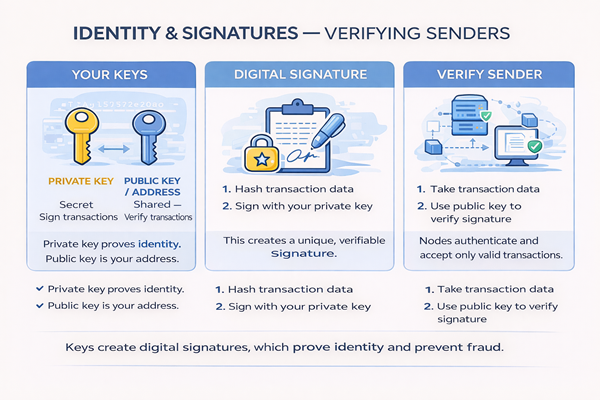
A self-custody wallet gives the user control of their private keys.
This can provide greater control over cryptocurrency ownership and reduce dependence on centralized custodians.
But a wallet does not make someone anonymous.
A blockchain address is pseudonymous rather than necessarily anonymous.
For example:
Person → Exchange account → Wallet → USDT transaction
The exchange may know the person’s identity, while the blockchain records the wallet’s transactions.
This is why users should understand the difference between self-custody, privacy and anonymity.
What About Buying USDT Without KYC?
The phrase “buy USDT without KYC” is frequently searched online.
KYC means Know Your Customer, a process used by many financial and cryptocurrency services to verify customers.
Depending on the platform and jurisdiction, KYC may involve information such as:
- Full name
- Date of birth
- Government-issued identification
- Address
- Phone number
- Email address
- Source-of-funds information
Some services may provide limited crypto functionality without traditional KYC, while others require verification before any meaningful transaction can take place.
The rules can also change over time.
Therefore, users should check the current requirements of the specific service and the laws applicable to their location rather than relying on an old “no KYC” list.
Is Buying USDT Without ID Legal?
This depends on where you live, which service you use and how the transaction is conducted.
There is an important distinction between:
Privacy:
Wanting to limit unnecessary collection or exposure of personal information.
and
Regulatory evasion:
Attempting to circumvent identity checks, transaction restrictions, sanctions, tax requirements or other legal obligations.
The first is a legitimate privacy concern.
The second can create serious legal and financial problems.
For this reason, Coin-Predictions.com does not recommend bypassing mandatory KYC requirements or using cryptocurrency services to evade applicable laws.
If a regulated service legally requires identity verification, attempting to circumvent that requirement may violate the service’s terms or applicable regulations.
Is USDT Anonymous?
No. USDT should not be considered completely anonymous.
USDT transactions on public blockchains can generally be viewed through blockchain explorers.
Depending on the network, observers may be able to see:
- Sending address
- Receiving address
- Transaction amount
- Transaction time
- Token transfers
- Contract interactions
The blockchain usually does not directly display a person’s name.
However, if a wallet address becomes associated with an identifiable person—for example through a centralized exchange-the transaction history associated with that address may potentially be analyzed.
Therefore:
USDT = pseudonymous blockchain asset, not guaranteed anonymous money.
Why Do People Want to Buy USDT Privately?
There are legitimate reasons someone may value financial privacy.
Personal financial privacy
Some people do not want every financial activity connected to a public identity.
Data minimization
Users may prefer not to provide unnecessary personal information to multiple companies.
Self-custody
Some cryptocurrency users want direct control of their assets rather than keeping funds permanently on an exchange.
International transfers
USDT can be transferred across supported blockchain networks without relying on traditional international banking rails.
Security concerns
Reducing the amount of personal information shared online can potentially reduce exposure to certain forms of identity theft and phishing.
However, privacy practices should always remain within applicable laws and platform rules.
Risks of Buying USDT Without Personal Information
Privacy-focused purchases can introduce additional risks.
1. Scams
A seller offering extremely cheap USDT or claiming to provide completely anonymous transactions may be attempting to steal funds.
Never send money directly to an unknown person without appropriate transaction protections.
2. Fake USDT
Scammers can create tokens with names and symbols resembling USDT.
Always verify the official token contract and blockchain network before accepting or sending tokens.
3. Irreversible Transactions
Cryptocurrency transactions generally cannot simply be reversed like a credit-card payment.
Sending USDT to the wrong address or incompatible network can result in permanent loss.
4. Counterparty Risk
With P2P transactions, the other party may attempt fraud, chargeback abuse or other forms of manipulation.
5. Regulatory Risk
A service marketed as “no KYC” may not be available legally or may have restrictions in your jurisdiction.
6. Higher Fees
Privacy-focused purchasing methods may sometimes involve higher spreads, trading fees, network fees or seller premiums.
7. Blockchain Traceability
Avoid assuming that a transaction is anonymous simply because no ID was requested.
How to Buy USDT More Safely
If your objective is privacy plus safety, consider the following approach.
Step 1: Choose a legitimate service
Research the provider before sending money.
Check:
- Company information
- Reputation
- Security history
- Supported countries
- Fees
- User reviews
- Withdrawal policies
- KYC requirements
Step 2: Understand the network
USDT can exist on multiple blockchains.
Confirm that the sender and recipient support the same network.
Step 3: Verify the token
Do not rely only on the ticker symbol “USDT.”
Verify the token contract through a reliable source or blockchain explorer.
Step 4: Start with a small transaction
If you are unfamiliar with a service or wallet, consider testing the process with a small amount first.
Step 5: Use escrow for P2P
Where available, use the platform’s official escrow and dispute mechanism.
Do not move the transaction to Telegram, WhatsApp or another private channel simply because a seller promises a better price.
Step 6: Protect your wallet
For self-custody:
- Keep your recovery phrase offline.
- Never share your seed phrase.
- Do not take screenshots of recovery phrases.
- Avoid unknown wallet applications.
- Verify transaction addresses before confirming.
Privacy vs. Anonymity: What’s the Difference?
This is one of the most important concepts for anyone searching for “how to buy USDT anonymously.”
| Privacy | Anonymity |
|---|---|
| Limits unnecessary exposure of information | Attempts to hide identity completely |
| Can involve self-custody | May involve stronger privacy techniques |
| Does not guarantee secrecy | Very difficult to guarantee |
| Can be compatible with regulated services | Can conflict with legal requirements |
| Focuses on control of personal data | Focuses on preventing identification |
For most legitimate users, better financial privacy is a more realistic goal than complete anonymity.
Can a USDT Transaction Be Traced?
Potentially, yes.
USDT transactions are recorded on their underlying blockchain.
Blockchain analytics can sometimes connect groups of addresses based on transaction patterns. If an address has interacted with a regulated exchange or another identifiable service, additional information may become available to investigators or compliance teams.
This does not mean that every blockchain address automatically reveals a person’s name.
It means that public blockchain data should not be treated as inherently anonymous.
Should You Use a “No KYC USDT” Service?
Use caution.
A website advertising:
“Buy USDT instantly – no ID, no verification, completely anonymous”
should not automatically be considered safer or more private.
Before using any service, ask:
- Who operates it?
- Is the service legally available in my country?
- How does it protect customer funds?
- Does it use escrow?
- What happens if the transaction fails?
- What fees are charged?
- What network does it use?
- Can the provider freeze transactions?
- Is there a legitimate support channel?
- What information does it actually collect?
No KYC is not the same as no risk.
What Is the Best Way to Buy USDT Privately?
There is no single best method for everyone.
If your priority is convenience, a regulated cryptocurrency exchange may be easiest.
If your priority is self-custody, you may prefer purchasing through a compatible crypto service and withdrawing to your own wallet.
If your priority is greater transaction privacy, you may investigate legitimate P2P or crypto-to-crypto options that are available in your jurisdiction.
The key is to balance:
Privacy + Security + Legality + Cost + Convenience
rather than focusing only on avoiding KYC.
USDT Privacy Checklist
Before buying USDT, ask yourself:
- Do I understand the platform I’m using?
- Is the service available legally where I live?
- Do I understand its identity requirements?
- Am I using the correct USDT network?
- Have I verified the token contract?
- Have I checked the seller or platform reputation?
- Is escrow available for P2P transactions?
- Do I understand all fees?
- Am I using a secure wallet?
- Have I backed up my recovery phrase securely?
- Do I understand that blockchain transactions can be publicly visible?
If you cannot answer these questions, research the transaction before sending money.
Frequently Asked Questions
Can I buy USDT without providing my ID?
In some circumstances, certain crypto-to-crypto or P2P services may offer limited transactions without traditional identity verification. However, many regulated services require KYC, particularly for fiat purchases. Availability depends on the platform and jurisdiction.
Can I buy USDT without KYC?
Some services may advertise limited no-KYC functionality, but requirements vary and can change. Users should not attempt to bypass mandatory identity verification.
Can I buy USDT completely anonymously?
Complete anonymity cannot be guaranteed. Even when a service does not collect your name, blockchain transactions can remain publicly visible and may potentially be linked to other identifying information.
Is USDT private?
USDT itself should not be considered a privacy coin. Transactions on public blockchains can generally be inspected using blockchain explorers.
Can I buy USDT with cash?
Some P2P arrangements may support cash-based transactions, depending on location and platform rules. However, cash transactions can carry significant counterparty, fraud and safety risks.
Is buying USDT without ID illegal?
Not necessarily. Legality depends on the jurisdiction, transaction method, platform and applicable regulations. The important point is not to confuse privacy with deliberately evading legal requirements.
What is the safest way to buy USDT?
For many users, a reputable and properly regulated exchange or established crypto service provides the most straightforward balance of security and convenience. Always verify the network and token before transferring funds.
Can USDT transactions be tracked?
USDT transactions on public blockchains can generally be observed. Whether a transaction can be connected to a specific person depends on the information available to whoever is analyzing it.
Does a self-custody wallet make USDT anonymous?
No. A self-custody wallet gives you control over your private keys, but transactions made from the wallet can still be visible on the blockchain.
Final Thoughts: Buying USDT With Privacy
Searching for “buy USDT without personal information” does not necessarily mean someone wants to hide illegal activity. Many cryptocurrency users simply want greater control over their financial data.
The important distinction is between protecting privacy and bypassing legal requirements.
If you want to minimize unnecessary personal-data exposure, consider legitimate self-custody, crypto-to-crypto swaps, reputable P2P marketplaces and privacy-conscious services where legally available. At the same time, understand that USDT transactions are not automatically anonymous, and blockchain activity can potentially be analyzed.
The safest strategy is to prioritize legitimate services, secure wallets, verified USDT contracts, correct blockchain networks and compliance with local laws.
Coin-Predictions.com provides cryptocurrency education and market information. This article is for informational purposes only and is not legal, financial, tax or investment advice. Cryptocurrency regulations and KYC requirements vary by jurisdiction and can change over time. Always verify the current rules applicable to you before buying or transferring USDT.
ReAD MORE Topics
- What Is USDT?
- USDT Price Prediction
- How to Buy Cryptocurrency
- How Crypto Wallets Work
- What Is a Self-Custody Wallet?
- Bitcoin vs USDT
- USDT vs USDC
- What Is KYC in Cryptocurrency?
- How Cryptocurrency Transactions Are Tracked
- Best Crypto Trading Platforms
- Crypto Security Guide