
Machine Learning Crypto Forecasting: How AI Predicts Crypto Prices
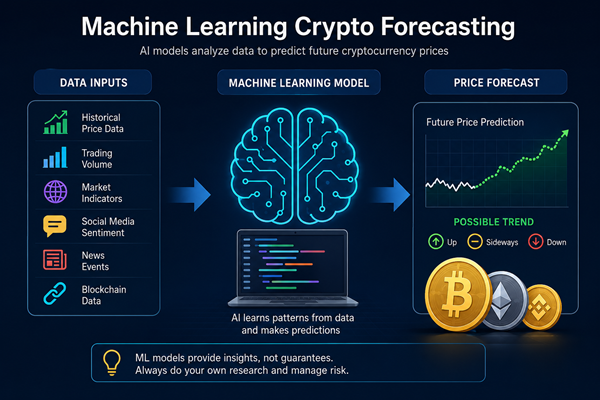
Machine Learning Crypto Forecasting: How AI Predicts Cryptocurrency Prices
Introduction: The Rise of AI in Cryptocurrency Prediction
Cryptocurrency markets are known for their extreme volatility, rapid price movements, and complex behavior. Unlike traditional financial markets, crypto markets operate 24/7 and are influenced by thousands of factors, including investor sentiment, global news, blockchain activity, trading volume, regulations, and technological developments.
Because of this complexity, many analysts and investors are turning to machine learning crypto forecasting to identify patterns, analyze large amounts of data, and generate potential price predictions.
Machine learning (ML) uses advanced algorithms that allow computers to learn from historical data and improve predictions over time without being explicitly programmed for every scenario. In cryptocurrency markets, machine learning models analyze past price movements, market indicators, and external signals to estimate future trends.
However, it is important to understand that machine learning does not predict cryptocurrency prices with certainty. Instead, it provides probability-based forecasts and insights that can support better decision-making.
What Is Machine Learning Crypto Forecasting?
Machine learning crypto forecasting is the process of using artificial intelligence algorithms to analyze cryptocurrency market data and predict future price movements.
Traditional technical analysis relies heavily on human interpretation of charts and indicators. Machine learning takes this process further by processing massive datasets and discovering hidden relationships that may not be obvious to human traders.
A crypto forecasting model may analyze:
- Historical cryptocurrency prices
- Trading volume
- Market capitalization
- Technical indicators
- Social media sentiment
- News events
- Blockchain activity
- Investor behavior
- Macroeconomic factors
The model learns from previous market patterns and uses this knowledge to estimate possible future price movements.
For example, an ML model may identify that when Bitcoin experiences a specific combination of trading volume increase, market sentiment improvement, and technical signals, there is a higher probability of price growth.
How Does Machine Learning Predict Crypto Prices?
Machine learning crypto prediction generally follows several important steps:
1. Data Collection
The first step is gathering large amounts of cryptocurrency market data.
Common data sources include:
- Historical price data
- Exchange trading data
- Blockchain metrics
- Social media platforms
- News websites
- Market sentiment indicators
For example, a Bitcoin prediction model may collect years of:
- Opening prices
- Closing prices
- Daily highs and lows
- Trading volume
- Market trends
The quality and quantity of data directly affect prediction accuracy.
2. Data Processing and Feature Selection
Raw cryptocurrency data is usually noisy and unstructured. Before training a model, the data must be cleaned and transformed.
Machine learning systems identify important features such as:
Technical Indicators
Examples include:
- Moving averages
- Relative Strength Index (RSI)
- MACD
- Bollinger Bands
- Trading volume changes
Market Indicators
Examples include:
- Market dominance
- Liquidity
- Exchange inflows and outflows
- Volatility levels
Sentiment Indicators
AI models can analyze:
- Twitter/X discussions
- Reddit activity
- News sentiment
- Search trends
These features help models understand both market behavior and investor psychology.
Popular Machine Learning Models Used for Crypto Forecasting
Different machine learning algorithms are used depending on the prediction goal and available data.
1. Linear Regression Models
Linear regression is one of the simplest forecasting methods.
It attempts to identify relationships between variables and estimate future prices.
Example:
If historical data shows that increased trading volume often leads to price growth, the model can estimate future price movement based on volume changes.
Advantages:
- Simple to understand
- Fast calculation
- Useful for basic trend analysis
Limitations:
- Cannot handle complex market behavior
- Less effective during extreme volatility
2. Random Forest Models
Random Forest is a machine learning technique that combines multiple decision trees to make predictions.
It is commonly used for cryptocurrency forecasting because it can analyze many factors simultaneously.
A Random Forest model can evaluate:
- Price patterns
- Market indicators
- Trading volume
- Sentiment signals
Advantages:
- Handles large datasets
- Reduces prediction errors
- Works well with multiple market factors
3. Support Vector Machines (SVM)
Support Vector Machines classify market conditions and identify patterns between different price movements.
For example, an SVM model may classify whether Bitcoin is likely to:
- Increase
- Decrease
- Remain stable
SVM is useful for identifying market trends but may struggle with highly unpredictable events.
4. Neural Networks
Neural networks are among the most advanced machine learning methods.
They are inspired by the human brain and consist of interconnected layers that learn complex relationships.
Neural networks can analyze:
- Historical prices
- Market cycles
- Multiple indicators
- Non-linear patterns
They are widely used in AI-based cryptocurrency forecasting systems.
5. LSTM Networks for Crypto Prediction
Long Short-Term Memory (LSTM) networks are a special type of neural network designed for time-series forecasting.
Cryptocurrency prices are time-dependent, meaning previous market movements influence future behavior.
LSTM models are effective because they can remember important historical patterns.
They are commonly used for predicting:
- Bitcoin prices
- Ethereum trends
- Cryptocurrency market cycles
Example:
An LSTM model may analyze several years of Bitcoin price data to identify repeating patterns and forecast possible future movements.
6. Transformer-Based AI Models
Modern AI forecasting systems increasingly use transformer models.
These models can process large amounts of sequential data and identify complex relationships.
Potential applications include:
- Crypto market forecasting
- Sentiment analysis
- Automated trading systems
- Risk analysis
Transformers are becoming popular because they can combine multiple data sources more effectively than traditional models.
Data Sources Used in Machine Learning Crypto Forecasting
Successful prediction models usually combine multiple data sources.
Market Data
Includes:
- Price history
- Trading volume
- Market capitalization
- Liquidity
Blockchain Data
On-chain information includes:
- Wallet activity
- Transaction volume
- Exchange transfers
- Network growth
Social Media Data
Investor sentiment can strongly affect crypto prices.
AI systems analyze:
- Social media discussions
- Community activity
- Trending topics
News Data
Machine learning models can analyze news headlines and determine whether market sentiment is positive or negative.
Benefits of Machine Learning Crypto Forecasting
1. Faster Market Analysis
AI can analyze millions of data points within seconds, much faster than manual analysis.
2. Identifying Hidden Patterns
Machine learning can detect relationships that may not be visible through traditional analysis.
3. Reducing Emotional Decisions
Human traders often make decisions based on fear and greed.
AI models provide data-driven insights without emotional bias.
4. Handling Large Data Volumes
Crypto markets generate enormous amounts of information every day.
Machine learning systems can process:
- Price data
- Social sentiment
- Blockchain activity
- Market indicators
simultaneously.
Challenges of Machine Learning Crypto Forecasting
Despite its advantages, AI-based cryptocurrency prediction has significant challenges.
1. Extreme Market Volatility
Crypto prices can change dramatically due to:
- Regulatory announcements
- Exchange failures
- Market manipulation
- Global economic events
These events are difficult for models to predict.
2. Limited Historical Data
Compared with traditional markets, cryptocurrencies have a shorter history.
Bitcoin launched in 2009, meaning AI models have fewer historical cycles to study.
3. Overfitting Problems
A model may perform extremely well on historical data but fail in real market conditions.
This happens when the algorithm learns past patterns too specifically.
4. Unexpected Events
Machine learning models cannot reliably predict:
- Government bans
- Security breaches
- Major industry announcements
- Sudden investor panic
Machine Learning vs Traditional Crypto Analysis
| Feature | Traditional Analysis | Machine Learning Forecasting |
|---|---|---|
| Data Processing | Manual | Automated |
| Data Volume | Limited | Millions of data points |
| Pattern Detection | Human-based | AI-based |
| Speed | Slower | Faster |
| Emotional Bias | Possible | Reduced |
| Complexity | Lower | Higher |
Both approaches can be useful. Many professional analysts combine traditional indicators with AI models.
Can Machine Learning Accurately Predict Cryptocurrency Prices?
Machine learning can improve cryptocurrency analysis, but it cannot guarantee accurate predictions.
Crypto markets are influenced by unpredictable human behavior and external events.
The best AI forecasting systems provide:
- Trend predictions
- Probability estimates
- Risk analysis
- Market insights
They should be used as a supporting tool rather than a guaranteed trading strategy.
The Future of AI-Based Cryptocurrency Forecasting
The future of crypto forecasting will likely involve combining multiple technologies:
- Machine learning algorithms
- Blockchain analytics
- Natural language processing
- Real-time market monitoring
- Artificial intelligence agents
Future models may become better at understanding:
- Investor psychology
- Global economic conditions
- Market manipulation patterns
- Network activity
As AI technology improves, machine learning will continue to play a larger role in cryptocurrency research and investment analysis.
Conclusion
Machine learning crypto forecasting represents one of the most promising applications of artificial intelligence in financial markets. By analyzing historical prices, market indicators, blockchain data, and investor sentiment, AI models can uncover patterns and provide valuable market insights.
However, cryptocurrency markets remain highly unpredictable. Machine learning should not be viewed as a crystal ball but as a powerful analytical tool that helps investors make more informed decisions.
For traders, researchers, and crypto enthusiasts, understanding how AI models work provides a significant advantage in navigating the rapidly changing digital asset market.